Have you ever been part of a team where everything just clicked? Where everyone supported each other, worked towards a shared goal, and celebrated success together? That’s the power of a high-performing team. These teams don’t happen by chance—they’re built with intention, care, trust, and strong leadership.
A good leader brings people together, helps them grow, and keeps everyone focused on what matters most. The role of a leader goes far beyond giving directions; it’s about creating an environment where people can thrive and collaborate seamlessly. So, what does it take to build a high-performing team?
To enable high performance, leaders must adopt specific strategies and behaviors that foster collaboration, trust, and productivity. Below are key strategies and frameworks that can guide this process:
Key Strategies for Building High-Performing Teams
1. Set Clear Goals and Objectives
Define long-term organizational objectives and break them into measurable short-term goals.
Use frameworks like SMART objectives to ensure clarity, focus, and alignment with team priorities.
Regularly review and adapt goals to reflect changing conditions or organizational needs.
2. Foster Effective Communication
Encourage open, two-way communication to build trust, reduce misunderstandings, and promote transparency.
Adapt communication styles to fit team dynamics and individual preferences.
Provide regular updates on progress, priorities, and organizational changes to ensure alignment.
3. Build Trust and Psychological Safety
Model trust, transparency, and empathy as a leader to create a culture where team members feel safe to share ideas.
Address conflicts promptly and constructively to maintain harmony and mutual respect.
Promote an environment where feedback is welcomed without fear of judgment or retaliation.
4. Promote Accountability
Set clear expectations for performance and hold individuals and the team accountable for results.
Lead by example—demonstrate accountability through your actions.
Use consistent feedback mechanisms to ensure accountability remains positive and constructive.
5. Encourage Continuous Improvement
Invest in team growth through training, coaching, and opportunities for skill development.
Recognize team members’ strengths and delegate responsibilities accordingly.
Empower creativity and innovation by giving team members ownership of their work.
6. Emphasize Diversity and Inclusivity
Build teams with diverse skills, backgrounds, and perspectives to drive innovation and problem-solving.
Foster an inclusive environment where all members feel valued and their contributions are acknowledged.
7. Celebrate Successes
Recognize both individual and team achievements to boost morale and motivation.
Use rewards, public acknowledgment, or team celebrations to reinforce positive outcomes and desired behaviors.
Supporting Frameworks for Team Development
Leaders can leverage tested and proven frameworks that can help kickstart their team’s transformation. Here are two relevant frameworks that complement each other—Lencioni’s approach fixes dysfunctions, while Tuckman’s model charts the natural growth of teams. Together, they provide a structured way to diagnose challenges and support leaders towards enabling team development.
Patrick Lencioni’s Five Dysfunctions of a Team
Patrick Lencioni’s framework identifies key areas that undermine team success and offers actionable steps for improvement:
Absence of Trust – Teams lacking trust fail to collaborate openly.
Fear of Conflict – Avoiding healthy debate stifles growth.
Lack of Commitment – Without clear agreements, teams struggle to take decisive action.
Avoidance of Accountability – Failure to hold one another accountable hinders performance.
Inattention to Results – A focus on individual success rather than team outcomes diminishes impact.
Tuckman’s Stages of Team Development
Tuckman’s model outlines the natural progression of teams as they mature:
Forming – Team members get acquainted and begin understanding roles.
Storming – Conflicts arise as dynamics and responsibilities are established.
Norming – Teams develop cohesion, trust, and norms for collaboration.
Performing – Teams operate at peak productivity, achieving results seamlessly.
Additional Insights: Combining Approaches
I recently explored Stephen E. Morris’s Leaders, Believers, and Expert Deceivers, where he highlights the importance of sense-making when applying frameworks. Often, a combination of approaches tailored to the team’s dynamics and organizational needs delivers the best results.
My Principles for Shaping High-Performing Teams
Drawing from my experience, I’ve developed principles that leverage a combination of the key strategies and frameworks that I have found critical to building and sustaining high-performing teams:
Cultivating a Shared Culture and Identity – Building a high-performing team requires nurturing a shared culture and identity. A strong sense of purpose and connection enables individuals to align their efforts, feel valued, and work cohesively toward common goals.
Creating a Shared Vision with Clear Guideposts – Bringing the team into a shared vision with clear milestones provides alignment, motivation, and focus. By defining priorities and setting achievable goals, teams understand their role in driving the bigger picture.
Flexibility in Strategies and Adaptability in Execution – Staying competitive requires flexibility in strategies and adaptability during execution. High-performing teams view challenges as opportunities to innovate, pivot priorities, and improve workflows.
Fostering a Culture of Trust and Collaboration – Trust is the foundation of any successful team. Creating an environment where members feel safe to share ideas, take risks, and collaborate openly strengthens relationships, fuels innovation, and enhances problem-solving.
Conclusion
By integrating proven frameworks, embodying effective leadership principles, and fostering a culture of trust and collaboration, leaders can unlock the full potential of their teams. High-performing teams are not built overnight—they require ongoing care, intentionality, and adaptability. However, the results are worth the effort: teams that consistently deliver extraordinary outcomes while fostering a culture of continuous growth and success.
About the author
Ginny is a Program Manager and Business Analyst with expertise in launching AI-driven SaaS products for GTM, RPA Automation, Digital transformations and Complex multi-country solution delivery.
Do organizational frameworks really drive results, or are businesses relying too much on oversimplified solutions for complex challenges? Stephen E. Morris’ Leaders, Believers, and Expert Deceivers tackles this question head-on, delivering a refreshing, no-nonsense approach to leadership and decision-making in organizational settings.
Morris invites readers to explore what it truly means to understand their organization’s unique context. Blending wit, humor, and a touch of cynicism, this book acts as both a guide and a mirror, challenging leaders to face uncomfortable truths about their teams and systems. With its sharp insights, it inspires meaningful change and fosters effective evolution of the organization to keep it relevant to its customers, their environment, and the people within it.
Whether you’re a seasoned executive or an eager team member, Leaders, Believers, and Expert Deceivers offers valuable insights into the complexities of leadership, product delivery, and organizational dynamics.
Key Themes and Messages
1. The Importance of Sense-Making
Morris emphasizes that every organization is a complex system requiring a clear understanding of its context before determining the best course of action. Sense-making—a concept originally coined by Karl Weick—is the foundation of this process. It’s likened to a music studio’s mixing desk, where each instrument must be adjusted to achieve the perfect harmony.
Sense-making isn’t just about understanding the external environment. It means interpreting an organization’s vision, purpose, and strategy while accounting for unpredictable elements like culture, habits, and human behavior. Using sense-making frameworks like Cynefin, leaders can foster meaningful discussions and determine their next course of action that align with their goals.
2. No One-Size-Fits-All Framework
Morris challenges the idea of universal leadership solutions. Instead, he highlights that a blend of approaches is often necessary. Organizations are a dynamic mix of predictable and unpredictable situations, requiring leaders to adapt their strategies for different contexts.
Why, then, do so many organizations adopt standardized frameworks? Morris identifies several reasons, from blindly following what the boss says to seeking quick fixes for complex problems. He offers a brutally honest critique of these tendencies, encouraging leaders to move beyond the comfort of one perfect framework. It involves leveraging existing frameworks complemented with the knowledge within the organization and its partners to establish tailored solutions.
3. The Role of Direction and Strategy
Knowing an organization’s purpose and aligning it with strategy can make all the difference. Morris outlines how clarity around vision, purpose, and objectives can empower teams, enhance decision-making, and foster a sense of belonging. He advocates for breaking down grand visions into manageable components and employing a variety of styles to make them more relatable and easy to understand, using tools like Objectives and Key Results (OKRs) and team-level discussions to keep teams aligned.
An example that Morris provides is IKEA’s effective use of their showrooms to visualize the application of their products in various spaces. On a similar note, organizations should not expect that a presentation of the corporate goals and strategy through mass email or a town hall meeting will result in alignment or a common understanding of the message. They have to make it relatable and relevant.
4. Complexity in Teams and Decision-Making
Morris explores how teams differ in function and structure, emphasizing the importance of applying the right type of team for a given task. He dives deep into the development of high-performing teams, stressing the role of skills, knowledge-sharing, and real-world experience over theoretical know-how.
A common misconception about organizational capabilities- skills and knowledge that employees have – falls under a bell curve. In reality, it takes on the Paretian principle (or the 80/20 rule), where the productivity of the organization is due mostly to the skills and knowledge of 20% of the employees, thus, the chart looks more like a hockey stick instead of a bell curve: the expertise lies on the far left of the chart and takes a deep dive into the right side of the chart. Morris promotes the importance of leveraging the 20% to support and enhance the skills and knowledge of the organization.
Additionally, he highlights the challenges of culture and habits, noting that successful change requires addressing behaviours rooted in comfort zones or reservations (or fear).
5. Understanding Change and Transformation
The book concludes with actionable advice on navigating change within organizations. Change, Morris argues, is inherently challenging because it disrupts established norms and triggers both physical and social fears. To succeed, leaders must carefully consider three specific thoughts:
Assume that both your change purpose and strategy will evolve – Embrace experimentation with different approaches, understanding that some will succeed while others may fail. It’s unrealistic to expect purpose and strategy to remain static, and trying to do so can lead to frustration for everyone involved.
Prioritize narrative difference – Share and leverage successes from various approaches, training sessions, tools, or techniques that foster collaboration and drive improvement across the organization. These stories can inspire growth and unity.
Iterate habits and heuristics – While these heuristics – mental shortcuts – can simplify and accelerate decision-making, it’s important to recognize when they become outdated. Actively work to adapt and transform these patterns into meaningful behavioral change.
Organizational Dynamics and Decision-Making
What sets this book apart is its nuanced exploration of organizational behavior. Morris dives deep into why organizations often stick to ineffective practices, offering thought-provoking explanations such as:
Blindly following industry trends or popular certifications.
Ignoring deeper problems because of cultural or habitual blind spots.
Avoiding accountability by relying on oversimplified tools or frameworks.
He doesn’t just stop at identifying these issues—he provides solutions and examples grounded in context, critical thinking, and communication. Exercises like mapping out future scenarios or running sense-making discussions provide tangible tools for overcoming real-world challenges. Morris encourages leaders to step away from the illusion of “one perfect answer” and instead champion open dialogue, diverse perspectives, and adaptive thinking.
Final Thoughts
Stephen E. Morris’ Leaders, Believers, and Expert Deceivers is both an eye-opener and a practical guide for anyone navigating the complexities of leadership and organizational decision-making. It challenges conventional wisdom, advocates for thoughtful exploration of context, and equips readers with tools to make informed, impactful decisions.
If you’re ready to think differently about leadership, challenge the status quo, and lead your teams with intention and clarity, this book is a must-read.
Call to Action
Take the first step toward transforming your organization—grab a copy of Leaders, Believers, and Expert Deceivers. Then, get ready to inspire meaningful change where it matters most.
About the author
As an Agile Evangelist, Rochelle Tan has over 20+ years of experience in agile transformation with small to large organizations from various industries in North America and Asia: Oil and Gas, IT, Healthcare, Finance, Insurance, and Government.
In the early 2000s, the world discovered a groundbreaking approach to software development: Agile. Grounded in essential values and principles, this method aimed to bring customers closer to the teams doing the work, while empowering those teams, speeding up delivery, and encouraging early feedback—all through an iterative development and continuous improvement process. But as anyone who’s implemented agile can tell you, there’s more to it than what you find in textbooks, blogs, or YouTube tutorials. It calls for the right tools to ensure everything runs smoothly.
In this article, we’ll dive into how specific tools can enhance value delivery by exploring how different tools support the five elements of the agile delivery framework. Whether you’re a Product Manager, Scrum Master, or Software Developer, this guide is crafted especially for you. Get ready to unlock the power of Agile with the right toolkit!
Why Tools
Matter
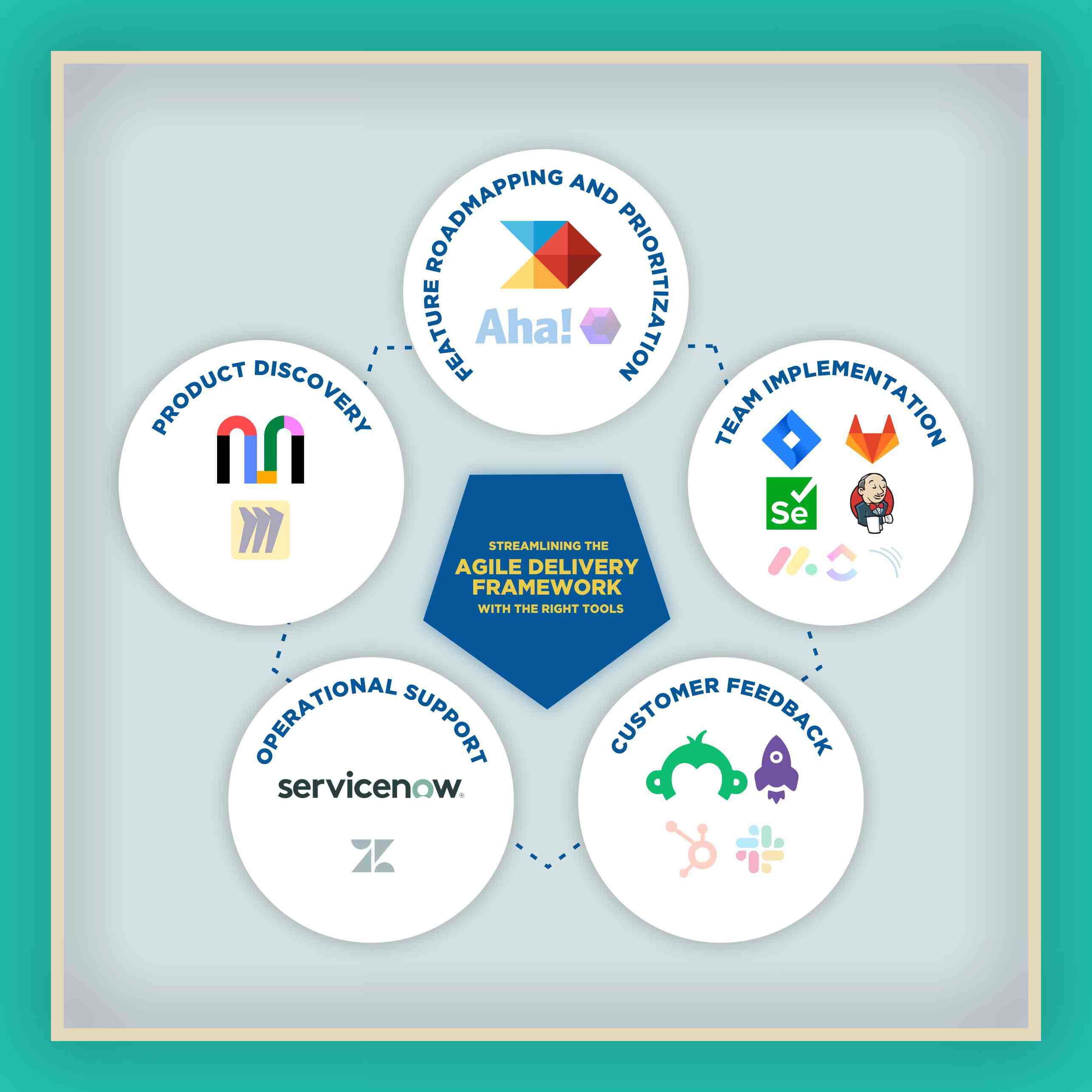
Remember the first time you tried to assemble IKEA furniture without an Allen wrench? That’s like attempting agile without the right tools. The goal here is to make life easier, not harder. From roadmaps to retrospectives, specialized tools can turn tedious tasks into streamlined workflows, freeing up your team to focus on what they do best—creating awesome products! Here are several industry-tested tools that effectively support the five elements of the agile delivery framework.
Before you can deliver, you need to discover what’s worth delivering. Product discovery is the secret sauce that turns good ideas into great products. Fortunately, tools are available to turn your brainstorming sessions into a process for identifying business capabilities and outstanding products.
Mural & Miro: These collaboration tools are like digital whiteboards. They allow teams to brainstorm, map out user journeys, and sketch wireframes. Whether you’re halfway around the world or across the hall, these platforms facilitate real-time collaboration.
Not all features hold the same importance. Some are crucial for deploying Minimum Viable Products (MVPs), while others are merely “nice to have’s” or can be postponed for future implementation. The trick is knowing which is which. Product management tools should facilitate the creation and execution of product plans as the product evolves through its lifecycle.
ProductBoard & Chisel: These tools help align your product vision with business capabilities. Incorporating AI for feature suggestion and prioritization, they can alleviate the administrative burdens on Product Managers.
Aha!: Perfect for visualizing features and aligning them with business capabilities, Aha! gives you a single place to manage your product plans.
Here’s where the rubber meets the road. Team implementation is the heart of Agile delivery, where ideas turn into reality. Team implementation involves the planning, execution, and delivery of high-value products to the customers when they want it. Tools that support the various aspects of team implementation must promote visibility, completion, automation, quality, and speed. Here are some products that many organizations have leveraged to support their value acceleration initiatives:
JIRA, Monday.com, & ClickUp: Trusted by Agile teams worldwide, these tools manage everything from backlogs to sprint planning. They allow you to set up workflows, track progress in real time, and even automate repetitive tasks.
SonarQube: Focused on code quality, this tool integrates seamlessly with your continuous integration pipelines to ensure that what’s being built meets your standards.
Jenkins, Selenium, and GitLab CI/CD: Automation is a critical component in Agile delivery by streamlining repetitive tasks and enabling teams to focus on more strategic activities. Automation tools like Jenkins, Selenium, and GitLab CI/CD enhance productivity by automating builds, tests, and deployments. These tools ensure that software is continuously integrated and deployed, reducing the risk of errors and accelerating the release of features.
Once a feature is live, the customer becomes your most valuable tester. Listening to them is key to continuous improvement. By providing an easy mechanism to capture user feedback and behavior with your products, you can develop features that promote stickiness and satisfaction.
Slack,HubSpot, SurveyMonkey, LogRocket: You can gather feedback directly from customer interactions or surveys, turning it into actionable insights.
Finally, don’t underestimate the importance of operational support. It’s the unsung hero of Agile delivery, ensuring everything runs smoothly. There is no perfect solution and products need to evolve with its customers’ changing needs. Thus, your organization must provide an avenue to collect requests or issues so that the implementation team can address them efficiently and effectively.
ServiceNow & Zendesk: These platforms streamline issue tracking and service requests, providing a structured system for managing incoming queries and problems.
An
Integrated
Approach
The tools are crafted to simplify information flow and optimize workflows, boosting collaboration and efficiency. Achieving this requires integrating these tools to ensure seamless connectivity between your processes, people, and the tools your team employs. Here’s an example of how an integrated system can lead to faster and higher-quality delivery.
Product Discovery
Product Roadmaping and prioritization
Team Implementation
Customer Feedback
Operational support
Product Discovery
LogRocket to analyze and gather user behavior and system response. Any issues are easily created in Jira without any manual encoding.
Operational support
ServiceNow for work intake (e.g., requests, enhancements, issues, inquiries)
Conclusion
Although the tools discussed in this blog are not an exhaustive representation of what’s available on the market or how tools are configured, they provide a starting point that you can review and revise to support your organization’s agile delivery framework. However, remember that these are merely tools; their true value lies in how they are utilized. Therefore, choose wisely, test carefully, and continually reassess to ensure they meet your needs.
The future of agile delivery is promising, but it shines brightest for those prepared to adapt and optimize. Isn’t it time your team joined the ranks of the streamlined and successful?
Navigating a Digital Transformation demands a solid strategy, transcending the outdated “Too big to fail” belief. History has shown us with Kodak, Nokia, MySpace, and Blackberry that complacency is not an option. Agility is imperative. Many organizations embark on this journey, but only a fraction succeed. It requires a lot to achieve the highest level of digital maturity. This is not about superficial adjustments or merely focusing on BAU (business as usual) but a comprehensive overhaul. It requires a genuine metamorphosis of resources, processes, culture, and mindsets. As Nassim Nicholas Taleb articulates, becoming antifragile is essential—organizations need the capability not just to endure change but to excel within it.
Why This Book?
Neil Perkin and Peter Abraham‘s “Building the Agile Business Through Digital Transformation” serves as an extensive guide for organizations aiming to embrace agility. It delineates the path to becoming an innovative organization that creates differentiating products and services. While not all-encompassing, the book delivers invaluable insights and strategies vital for any transformation leader. As a Digital Transformation Consultant, I regard this book as an indispensable resource, offering expert guidance through concepts, frameworks, and real-life use cases on cultivating an agile business.
Structure of the Book and This Review
The book offers flexible reading options. Beginners in digital transformation and agile practices should follow the authors’ recommended sequence for better comprehension. More seasoned transformation leaders might prefer to jump directly to Part Five, which integrates the tools, techniques, frameworks, examples, and concepts discussed in Parts One through Four. You can then explore the earlier sections for specific details as needed. This book review presents the 5 core dimensions for becoming an agile business, highlights the key concepts for each agile business component, and warns of potential pitfalls for companies where digital transformation has not succeeded.
Key Components of an Agile Business
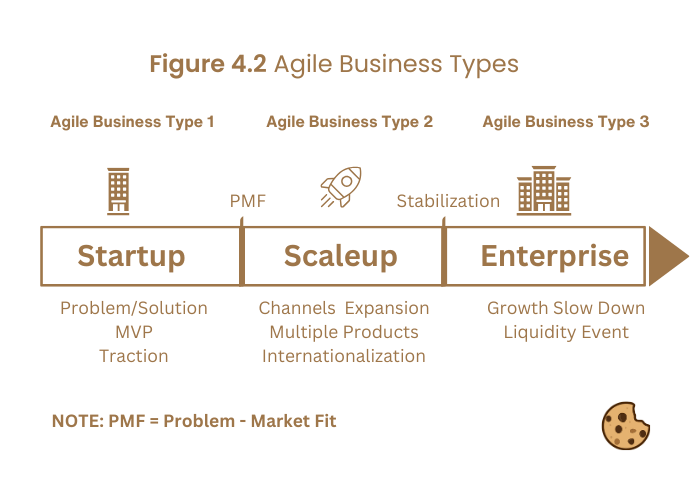
One of the key information to help transform an organization is to understand its agile business type. It helps the organization determine its digital business maturity (see Figure 4.2 Agile business type), which supports the creation of the organization’s blueprint to create its own digital transformation roadmap. According to Perkin and Abraham, the transformation journey is complex and multifaceted, but regardless the agile maturity of a business type – startup, scaleup, and enterprise – transformation leaders must account for these 5 key components:
Startup: Focused on early-stage experimentation.
Scaleup: Growth-oriented, expanding capabilities.
Enterprise: Mature organizations embedding agility in processes.
1. People
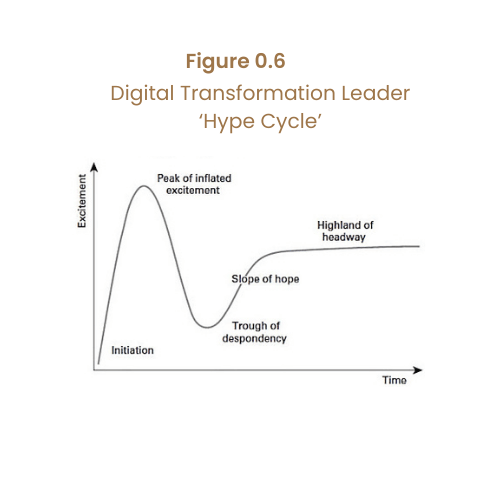
A common trend among organizations is a sudden peak in interest in the beginning of the digital transformation initiative. There is curiosity and strong interest among team members. Although every person likes to do well, the ‘hype cycle’ (Figure 0.6 Digital transformation leader ‘hype cycle’) usually takes a dip after the team realizes the complex challenges they have to navigate and overcome in this journey. The authors provide great ideas to maintain interest and consistently make progress towards becoming an agile business beyond the initial ‘hype’. Some of these ideas are as follows:
It is crucial for everyone to share a vision and have the autonomy to execute on these objectives because it promotes inclusivity and ownership.
Every person’s effort must serve the customer.
It is important to identify advocates to promote the endeavor and recruit supporters.
2. Principles
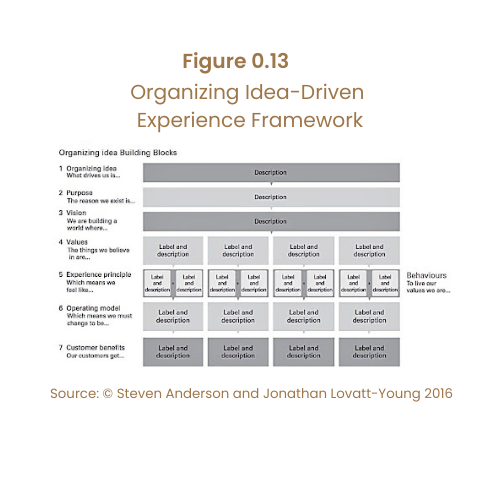
Digital transformation is a multifaceted undertaking with numerous intertwined dependencies. Crafting a playbook to cover every possible scenario and response is impractical. Instead, the organization should align with a unified vision and direction for change; the organization must be oriented around foundational principles, values that shape everyone’s behavior. This approach nurtures a sense of tribalism, fostering shared loyalty and purpose for diverse teams working concurrently and on varying initiatives. The authors offer the idea-driver experience framework (see Figure 0.13 from the book) as a tool that organizations can use to identify and align everything and everyone.
3. Process
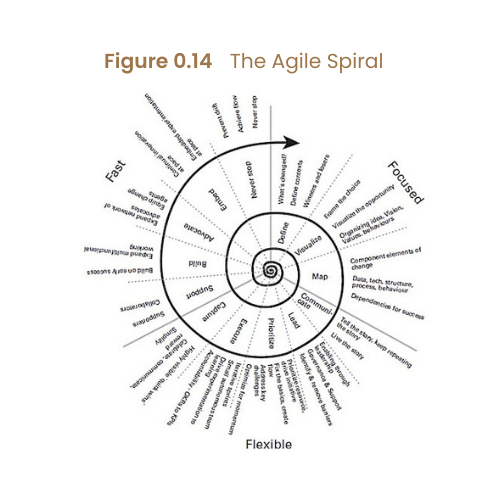
In the quest to create a more digital-native framework, organizations aim for speed, focus, and the environment and culture that enables transformative change. Today, organizations must learn to operate fast, iteratively, and in a non-linear model (i.e., run multiple elements concurrently). There is no specific beginning, middle, and an end. It operates in a continuous state of organization flex and flow, which best describes the agile spiral model.
The 3 foundational components of the agile spiral model is summarized below:
Situation and story – create the reason and impetus for change by leveraging storytelling to appeal to people’s senses and bring them along in the journey.
Energize and enable – do not just execute but also energize the drivers of change, prioritize the work, remove barriers, build momentum, and amplify positives.
Flex and flow – support the effort with a network of supporters and collaborators , build on early success, create as many advocates, embed constant experimentation into resourcing, and never stop working to resist inertia (non-action or losing interest).
4. Practice
For true transformation to occur, something more fundamental than best practices must happen. Perkin and Abraham emphasize the need to identify the factors that shape everyday behavior. Author Clive Hyland has written about a simple behavioral model that is a helpful tool in recognizing ways to appeal to people’s way of thinking, senses, and intuition to drive the most fundamental and long-lasting change in the organization. This technique is a good tool to use for changing an individual’s habit and can be leveraged to transform an entire organization’s culture and behavior.
Think – which includes the domain of logic, reason and rational processing.
Feel – which touches the sense, emotions, relationships, connections.
Know – which consist of the domain of instinct, intuition or gut feel.
5. Pace
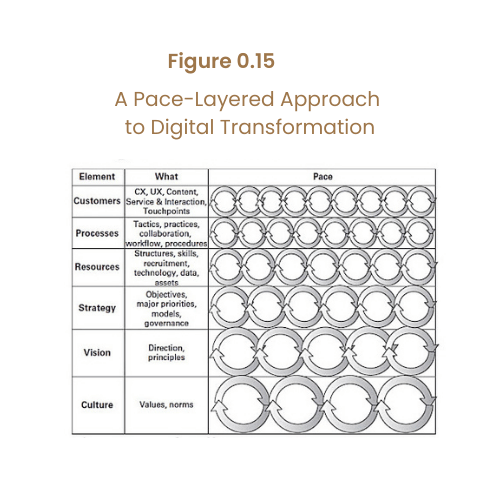
According to Perkin and Abraham, organizational change does not happen instantaneously, and it happens at different times with different pace. There’s a combination of addressing technical challenges and adaptive challenges, which solves more complex and fundamental problems. They are different and cannot be solved rapidly; they will require experimentation, learning, and behavioral change across the organization. Recognizing and understanding the elements and pace of change helps the organization plan, execute, and adjust efforts to drive transformative shifts for an organization to become a true agile business.
Conclusion
Digital transformation is more than upgrading technology; it requires drastic and fundamental changes (e.g., cultural shift). This book helps transformation leaders create their transformation roadmaps through the 5 key components and leveraging the framework, tools, techniques, and real-life examples. For those ready to lead (or are leading) their organizations into the future, this book is an essential resource. Explore its pages to not only uncover the insights and actionable strategies for your digital transformation journey but also to create your organization’s own agile transformation roadmap.
Ever feel like networking is just a grown-up version of trying to make friends at school? Instead of lunch tables, we’re navigating conference rooms, and trust me, the awkward small talk is REAL! We’ve all been there—stuck in a conversation that feels more like an interrogation than a friendly chat. But here’s the secret sauce: those cringe-worthy “What do you do?” moments can spark something truly magical!
My journey through networking started when I was a nervous rookie at Columbia University. I remember stepping onto campus, feeling a mix of excitement and anxiety. I had this vision of a vibrant community where I’d make lifelong connections and gain invaluable insights. Little did I know that my greatest lessons would come from unexpected conversations during those initial networking attempts.
Coffee Chats and Chance
Encounters
Imagine turning an awkward hello into a high-five over a collaborative project! In my experience, those casual coffee chats and chance encounters can unlock doors I didn’t even know existed. I quickly learned that networking isn’t just about exchanging business cards; it’s about forming genuine relationships and understanding that every conversation holds the potential for growth.
I met someone in one of my classes—let’s call him Dan. As we navigated the sometimes stressful world of internship applications, we found ourselves at a café, sharing our aspirations and anxieties.
Over coffee, he shared something that shifted my perspective entirely: “Don’t chase titles; focus on building skills.” His words struck a chord, especially as we were both looking to break into competitive roles.
Dan had a knack for breaking down complex topics, like Python coding, into digestible insights. He shared his journey of prioritizing skill development over job titles. “The titles will come,” he said, “but it’s the skills that truly set you apart.” Hearing that from someone so grounded and humble made it all the more impactful. His focus on honing his abilities rather than seeking immediate accolades inspired me to view each opportunity as a chance to grow.
Now, whenever I approach a new role or project, I think of it like a “skills bootcamp.” Instead of fixating on the next step up the ladder, I dive deep into what I can learn from the experience. Dan’s advice didn’t just change my career perspective—it reshaped how I value each moment in my professional journey.
Learning from
Mistakes
Then there was someone I’ll call Priya, who had a background in management consulting. She seemed effortlessly put together but shared with me her early struggles in the industry. During one of our conversations, we swapped stories about the tough feedback we had received. She laughed and recounted, “I used to feel like each mistake was proof I wasn’t cut out for this.” It was refreshing to hear someone so accomplished admit that she had stumbled along the way.
Priya’s perspective was like a breath of fresh air. She approached every setback as part of her own “learning curve,” rather than viewing it as a failure. “Trust me,” she told me, “when you stop beating yourself up and start asking, ‘What can I learn from this?’—everything changes.” Her words turned into my go-to reminder. I could practically visualize her learning curve zig-zagging through all her ups and downs. Suddenly, mistakes felt less intimidating.
Priya’s approach has given me newfound resilience to tackle challenges head-on. I now pause whenever I hit a bump and ask myself what I can learn from it. That simple shift in mindset has not only made my experiences more enriching but has also fostered a sense of empowerment. Each conversation with Priya reminded me that it’s okay to embrace imperfection and that growth often comes from our most challenging moments.
Embracing the
Journey
Networking is not just a means to an end; it’s an ongoing journey. Each encounter, whether it’s a casual coffee chat or a structured event, holds the potential for invaluable lessons and surprising connections. Whether you’re a networking ninja or just dipping your toes into this adventure, approach it with an open heart and mind.
As I reflect on my journey, I realize that the relationships I’ve built and the insights I’ve gained have shaped not just my career but also my understanding of myself. I’ve learned that vulnerability can be a powerful connector, and sharing our stories—our fears, mistakes, and triumphs—can create bonds that last well beyond the initial meeting.
So, the next time you find yourself in an awkward networking situation, remember that it’s not just about making connections. It’s about fostering relationships and discovering the magic that happens when we share our journeys with others. You never know where a simple conversation could lead you—perhaps to a collaborative project, a mentorship opportunity, or even a lifelong friendship.
Let’s embrace the power of networking together. After all, the magic often happens when we least expect it—like stumbling upon a hidden gem in a bustling market: surprising, delightful, and sometimes life-changing!
Are you leading the AI revolution, harnessing its power to optimize your workflows, data, and processes? Or is your organization grappling with the absence of an AI strategy? The impact of AI has never been more profound. Businesses worldwide are striving to tap into AI’s potential and navigate its rapid advancements. Staying updated with the latest knowledge and skills is crucial. But with an overwhelming flow of information and the complexities of AI, where should you begin? The solution lies in crafting a personalized learning framework tailored to your needs. This strategy will not only help you stay organized and focused but also maximize your learning potential.
Key Components of Your Learning Framework
1. Assess
Begin by assessing your current AI knowledge and skills. Take an honest look at what you know and identify areas for improvement. This assessment will serve as the foundation for setting specific, achievable goals. Once you’ve identified your goals, develop a clear plan of action. Whether it’s mastering machine learning algorithms or exploring natural language processing, your roadmap should guide you towards your desired outcomes. Have a look at the AI Learning Assessment.
2. Learn
Everyone has a unique learning style, and it’s important to explore various learning opportunities that suit your preferences. Visual and tactile learners benefit when they can see or physically interact with the material, while auditory learners might prefer listening to information or accompanying their studies with calming music. Regardless of how you learn best, there are numerous courses and resources available both online and in-person to support your journey:
Online Courses: Platforms like Coursera, edX, and Udacity offer in-depth courses on AI, taught by industry professionals.
AI Tools: Engage with powerful AI tools such as TensorFlow, PyTorch, and Jupyter Notebooks to acquire practical experience.
TensorFlow provides a comprehensive ecosystem for building machine learning models, PyTorch offers dynamic computation graphs for flexible experimentation, and Jupyter Notebooks enable interactive coding and visualization, helping you acquire practical experience in developing and deploying AI solutions.
University Programs: Consider joining university programs or workshops that offer structured learning paths and mentorship. Many certificate and diploma programs are available to enhance your expertise. Examples of these are Georgia Tech’s Master’s in Analytics
3. Network
Expand your knowledge by leveraging professional networks. Join AI-focused groups, attend symposiums and conferences, and participate in Meetups. Engaging with practitioners and other professionals will expose you to new insights, diverse perspectives, and potential collaborators. Networking is an invaluable component of your learning framework, offering both inspiration and guidance.
4. Integrate
To truly internalize your learning, incorporate AI tools into your daily tasks and projects. This practice will bolster your AI proficiency and enhance your productivity. From simple note-taking to complex self-healing AI applications, a wide array of use cases awaits exploration. By integrating AI, you’ll uncover tools that streamline your work, particularly in administrative and routine tasks such as organizing, testing, data extraction, and processing. This allows you to focus on high-value activities like strategizing, collaborating, motivating, and synergizing, ultimately leading to a more efficient workplace and better products and services in less time. Many companies are experimenting with new AI-driven products and are keen to learn from users like you to align their features with your needs. Seize this opportunity to get involved and be a trailblazer.
Challenges in Developing Your Learning Framework
Creating a personal learning framework comes with its own set of challenges:
Finding the Time: Balancing learning with other responsibilities can be demanding.
Developing Discipline: Staying committed to your learning goals requires discipline and perseverance.
Determining Priorities: With so much to learn, figuring out what to focus on first can be overwhelming.
To overcome these challenges, dedicate specific time for learning, establish realistic milestones, and remain adaptable. Adjust your plan as necessary to integrate new interests or accommodate changing circumstances. In my experience, numerous organizations I work with promote the 20% rule, which encourages dedicating 20% of one’s time to learning activities. This could entail reading a new book, enrolling in a course, or exploring new ideas unrelated to current work assignments. Exploratory and experimental learning frequently results in innovative products. This is evident in Google’s creation of Gmail, Meta’s introduction of the ‘like’ feature on Facebook, and Atlassian’s development of the Jira Service Management portal.
If you’re struggling to find time to learn, consider the next time you check your phone, play video games, or binge-watch Netflix, think about the time you’ve spent on these activities. Can you carve out a fraction of that time for your own learning and growth? You can still do these things, but consider setting aside just 15 minutes a day for learning. I used to defer my reading, but I always seemed to find time for online reels. To keep myself accountable, I started a book review section on www.InBiteSize.com. Each month, I review a book on topics that might interest transformation leaders like me. I can’t read a whole book in one sitting, but I make time to read each day. Eventually, I finish the book in a few days or weeks. Now, when I’m traveling or waiting at the doctor’s office, I bring out my book.
Benefits of Using Your Learning Framework
Despite the challenges, employing a structured learning framework offers numerous benefits:
Self-Awareness: It provides a clear gauge of where you are in your AI journey and where you aspire to be.
Habit of Growth: Cultivating a habit of continuous learning fosters personal and professional growth. This is applicable for learning AI and for other types of learning in the future.
Adaptability: Your framework evolves alongside your learning, allowing you to stay current with advancements in AI.
Creating a personal learning framework is a strategic move towards mastering AI, empowering you to take control of your education and equipping you with the tools for success. It sets you on a path of lifelong learning and growth.
There’s no better time than now to begin, as many organizations are just starting to discover practical, market-worthy applications for AI. The race has begun, but it’s still in its early stages. Begin crafting your framework today, and soon you’ll be well on your way to becoming an AI expert.