When I started at PlayStation back in January of 2022, it was quite the adjustment. Unlike many of my peers, it was my first job move after graduating from college. I didn’t know what I was getting into. What I did know was that the most important step was to listen and observe. Beyond that, I was given the freedom to foster a community of relentless improvement and cultivate an environment where my teams could thrive.
With those two prime directives, I set forth and summoned an unlikely hero to help my team, the Goats of Tsushima, survive the forways of game development. Who might this unlikely hero be? Meet Microsoft Whiteboard.
In this blog post, we’re continuing our tools and template series and introducing a collaboration tool that may already be part of your arsenal.
The secret powerhouse
If your company leverages Microsoft 365, then you probably didn’t know that you also get Microsoft Whiteboard. As a result, you don’t need any license agreements or subscriptions to get started. Anyone can create a whiteboard, and you can share it with anyone within your company as long as they also have a Microsoft 365 account, too. Plus, Microsoft offers a Getting Started Guide to jumpstart your usage.
Microsoft Whiteboard operates similarly to other tools in the market. Once you create a board, you are able to leverage existing templates ranging from brainstorming to ice breakers to strategy and planning and beyond. If you are feeling creative and/or cannot find one that fits your needs, you can build your own template that you can share with your colleagues. From there, you and your teams can use an array of tools, which include sticky notes, text boxes, and emojis, to share ideas and align on outcomes. In addition, there is a timer feature that helps you keep your discussions on track.
When all is said and done, the nice part is that Whiteboard integrates with Microsoft’s Active Directory (AD) so that you can quickly manage the permissions to your various whiteboards. For example, if you already had a distribution list that you used in Microsoft Outlook, such as “goats-teammembers@inbitesize.com,” then, when using the share option, you can simply add that email instead of adding all the individual group members to the board.
Where it wins is its integration with Microsoft Teams. As long as you have three participants, you can open the Whiteboard app to quickly get folks brainstorming in a virtual and/or hybrid environment. The whiteboard will remain as a tab when navigating to the meeting within Microsoft Teams so that you and your teams can quickly reference the right board and continue adding any details asynchronously. Beyond that, you can share the board with teammates who may not have been invited to the meeting.
Growing pains
Just like its competitors, Microsoft Whiteboard has its own limitations. Unfortunately, you are not able to organize your boards into projects and/or folders. Therefore, you’ll have to share your boards with the appropriate groups each time. As a workaround, I have set up a naming convention so that I can quickly find the boards I need to reference.
In addition, you have a limited selection of widgets. One of the key aspects of other tools in the market is that you can organize various objects into frames that you can hide and group, which helps with board formatting. Since you cannot organize your board into sections, there may be a limit to your participants’ focus and attention if you happen to be covering a lot of topics within your workshop. For me, I use blocks and other sticky notes to temporarily hide sections that I may not be ready to tackle.
Furthermore, if you happen to be working with external partners who may not be part of your Microsoft tenant, they will lose access to the Whiteboard once they leave the Microsoft Teams meeting. I leverage screenshots and post-meeting summaries to help keep everyone on track. (Note that they will be able to contribute as long as they were invited to the Teams meeting and your administrator has allowed access to external folks.)
Despite these limitations, Microsoft is committed to continuously evolve the tool. Be sure to check out their webpage for the latest changes.
Listen and observe
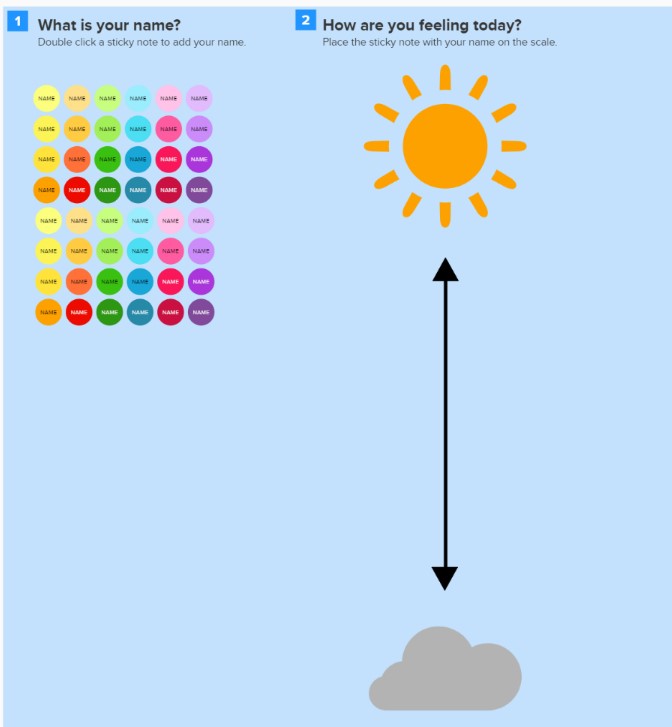
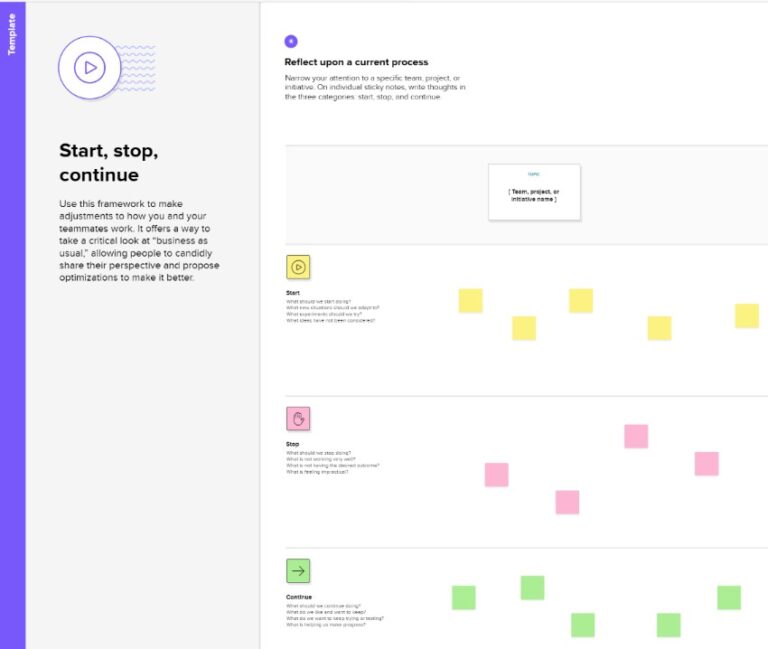
Now you may ask how did Whiteboard become an unlikely hero for us Goats? When I first joined the Goats, they had strong agile practices and knew the importance of reflecting and taking action sprint after sprint. As a result, they were actively using Google Jamboards to run their retrospectives. The good thing about the Goats was that they were a very vocal and engaged team. This meant that we quickly ran out of real estate and had to use many slides to collect all our ideas.
Hence, I introduced Microsoft Whiteboard. It was easy to transition since the tool had a similar user experience as Jamboard. Since then, we have had an endless amount of space where everyone has had a chance to share their ideas and vote on a path forward.
Beyond retrospectives, we have also used Microsoft Whiteboard to break down features and their associated use cases into bite-size chunks. To do this, we would leverage the tool to diagram customers’ journeys and sort & collect assumptions and questions that we had to validate with our stakeholders.
In conclusion
Microsoft Whiteboard is an effective contender when you’re on a budget and need a space to collaborate, fast. With its collection of templates and built-in Microsoft Teams integration, this tool can stand in for any whiteboard session and potentially pave the way for future tools like, Miro and Mural. So, get a leg up from your peers and show them this world of virtual collaboration that you can set up anytime and anywhere. How has Microsoft Whiteboard saved the day for you?
Drop us a line and let us know what tools you’re curious about.
Human beings are constantly faced with a barrage of decisions, ranging from the mundane to the monumental. A decision requires a choice among a set of alternatives and inevitably, carries consequences, both positive and negative. In product management, decision-making is a critical component of the job requirements from product visioning to features prioritization and from making trade-offs to creating evolutionary solutions. Effective decision-making fuels product innovation, solves complex problems, and yields positive business outcomes. In this blog post, we will explore the insights on decision-making presented by Malcolm Gladwell in his book, Blink, and how it applies to product management.
1. Expertise
Gladwell highlights the importance of expertise in decision-making. Expertise is the result of prolonged practice and experience within a specific domain. Many successful decision-makers, such as doctors, sports coaches, salespeople, and firefighters, are experts in their fields. Their expertise allows these individuals to make decisions effortlessly. This is often done with great precision without being able to explain their decision-making process. We sometimes say that these people have “the eye for it”. This is clearly depicted by a few experts that Gladwell pointed out in the book, one of which is Vic Braden, a tennis coach. By looking at a player’s form, Branden can accurately predict whether the tennis playe is about to make a mistake or score an Ace. When asked how he does it, he cannot tell you exactly what he saw, but with his experience, he can foresee the success rate of an athlete with such a high level of accuracy. In a product management context, incorporating expert perspectives lead to innovative products and services that may become market disruptors. Expertise could come from a blend of domain knowledge, market experience, and technical solution expertise.
2. Gathering Information
Gladwell also highlights the importance of gathering information before making a decision. A well-informed decision is based on relevant data collected from a variety of sources—only to a certain extent. One case study, presented by Gladwell, was from the Cook County Hospital ER in Chicago, which is ran by Dr. Brendan Reilly. Dr. Reilly promoted the use of the Lee Goldman decision tree algorithm to help diagnose a patient’s likelihood of having a heart attack (aka acute myocardial infarction). Comparing the results of doctors using this algorithm showed a faster and higher accuracy rate than the more conventional, and more costly, process of diagnosing a patient. When it comes to product management, gathering information involves conducting market research, taking feedback from customers, and gauging the competition. This Information provides the decision-makers with the latest trends and market changes. At the end of the day, it is the product manager’s responsibility to process the data and translate it to a tactical body of work that the teams can implement. The goal is to create products and services that customers will want and pay to have. In this digital environment, having good enough information is more valuable than waiting for the data to be perfect.
3. Instant vs Time/Space
In Blink, Gladwell emphasizes the importance of quick decision-making. He claims that decisions made in the blink of an eye can often be just as accurate as those made over an extended period of time. Gladwell’s focus on quick decisions is practical for product managers who often face high-pressure, time-constrained situations. That said, making quick decisions isn’t a universal rule. In some scenarios, taking time and creating space to think can lead to better decision-making outcomes. It’s important to strike a balance between speedy and well-thought-out decision-making and quick, blink of an eye decisions. To help with this balance, product managers who build products within an agile framework are allowed to work iteratively and switch between well thought-out vs. quick decisions. For example, each iteration is time-boxed to allow product management and the implementation team time to deliver value in small increments to their customers. This lends to shorter and faster learning cycles in which the team receives continuous feedback in each delivery. Feedback from customers’ comments and behaviors provide insight on whether to pivot or persevere on the current product/service development and delivery process. This saves time and monetary investment and allows the team to only focus on building products and services that the customers truly want. In Mr. Gladwell’s words, it’s important to strike a balance. There needs to be a balance between instinctive versus deliberate thinking.
4. Context Matters
Gladwell also explores the context in which decisions are being made. Decision-makers may fall into a trap of making decisions based on “not so accurate” information. The source and manner of which the data or how data was retrieved is crucial to the context it provides. Case in point is the Coca-Cola vs. Pepsi sip test. There was a time when Coca-Cola decided the need to create New Coke. Based on extensive sip tests in various cities across the US, the testers seem to prefer Pepsi over Coke. This led to the Coca-Cola company to think that they needed to sweeten their formula, which seems to be the deciding factor for sip testers. However, this product was a complete flop. Coca-Cola’s management team realized that the sip test did not represent how Coke’s original patrons normally drink the product. In fact, Coke is known for its extra fizzy content, which is only active during the first minutes of opening a can or a bottle. During the sip test, samples were usually sitting out in the open for a long period of time before the actual sip test was conducted. As a result, the sip test results provided a different context than how the customers actually consumed the product. This situation should hit home to the product discovery process, which is crucial to driving important decisions on what features and functionalities should be incorporated to existing products or if there’s a need to diversify with alternatives. Doing the Gemba walk is just one of the many techniques that product management can do to get solid information. This means product managers or their representatives observe, or even participate, in the customer’s experience in order to gain insights as to the nature of the customer’s work and the challenges or opportunities that the experience brings to light.
5. Not Bias, Not Prejudiced
Lastly, Gladwell talks about the negative effects of biases and prejudices in decision-making. Biases can cause a decision-maker to overlook certain facts or make a choice based on personal opinions rather than cold facts. Gladwell provides several examples of how bias and prejudices resulted in negative results, while the absence of it led to revolutionary changes. One of these positive changes was with the symphony audition. By doing screened auditions (musician’s identity is hidden behind the screen while auditioning) Abbie Conant, trombonist for the Royal Opera of Turin, and Julie Landsman principal French hornist at the Me were selected to be first chairs on previously considered as male-only instruments. In product management, removing bias from decision-making creates rational and objective product decisions. This is done by using a variety of techniques, such as Behavior-Driven Development (BDD), Design Thinking, Voice of the customer, and Canary Testing.. This promotes the creation of solutions that the customers really want rather than those based on what the product management thinks the customer wants. As an example, Behavior Driven Development (BDD) is a quality management approach used in software development. It is an extension of Test Driven Development (TDD). It promotes the creation of test cases before even building the solution. Initial tests will fail until the solution or body of work is completed and eventually passes the test based on the action/behavior that the customer expects from the solution. This aligns the solution with the customer’s needs rather than the developer or product manager’s expectations.
Conclusion
In conclusion, decision-making is an essential aspect of product management. Gladwell’s Blink provides insightful perspectives on how to make effective decisions in various contexts by using a five step approach. These five elements– incorporating expertise, gathering information, striking a balance between instant and time-consuming decision-making, considering the context, and ensuring that decisions are not bias or prejudiced– are all vital parts of effective decision-making. Ultimately, decision-making is not a one-size-fits-all approach, and product managers must tailor their decision-making strategies according to the specific product, stakeholders, and the ever-changing market landscape.
What’s the last book that left you thinking differently? Share your recommendations below! Be sure to take a look at our review of the book “The Tipping Point” by Malcolm Gladwell.
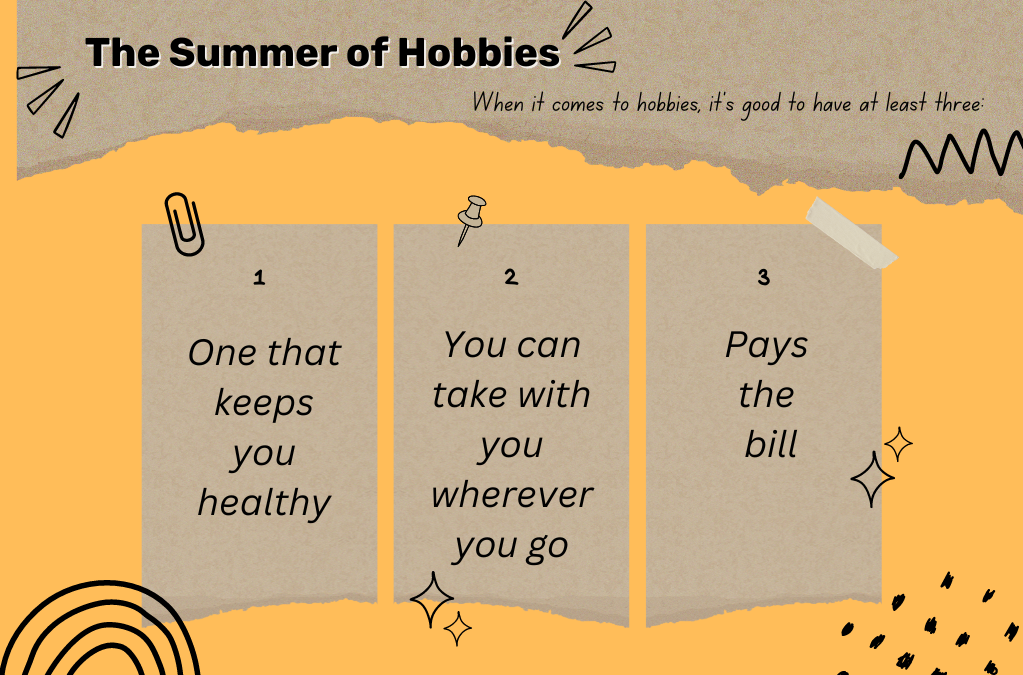
One year after leaving my childhood home and making the career move to California, someone told me how they led their life, which threw me into an existential crisis. The guidance went something like this: When it comes to finding hobbies, it’s good to have at least three, one that keeps you healthy, one that you can take with you wherever you go, and one that helps pay the bills.
The guidance sent me into a downward spiral regarding the meaning of life. I realized that I didn’t have a single hobby. My day-to-day routine was pretty steady: wake up, go to work, eat dinner, prep for the next day, go to bed, and repeat. The reason may have been because I had always been a risk-avoidant person and a stickler to the rules. As a result, there was no room for hobbies. It was all about surviving and getting from point a to b as safely and quickly as possible.
Things have changed now, for a variety of reasons– the pandemic; entering my 30’s; and living by myself. I’m happy to say that with a bit of inspiration from friends, colleagues, and Spotify podcasts…I have found lists of hobbies!
One that keeps you healthy
As defined by Merriam-Webster, a hobby is a pursuit outside one’s regular occupation engaged in especially for relaxation. With the restrictions of the pandemic, I had lots of time to “find” relaxation and learn how to find hobbies. The perk of being in the Bay Area was that the weather is divine, so I had the chance to breathe in the fresh air and walk every street in my neighborhood. As time moved on and we entered the new age of 2023, I started to lack discipline. After a long day of work, I chose lying in bed and scrolling through social media over venturing outside.
Flash forward to June 2023, I was in the middle of house hunting, wedding planning while managing critical projects at work. I was overwhelmed and not taking care of myself. Then, my good friend Maria came in and told me how she got into biking and was planning to do a duathlon. I had sheepishly said my new bike was collecting dust and taking up critical space in my 450 sq ft cottage. If I were to keep the bike, then I must use it. As a result, I signed up for my first professional race, which consists of 13 miles of biking and four miles of running—- more than I have ever done in my life!
I created a vigorous training plan to track my progress and find a new hobby. Now, I’m hooked on the sport! To be honest, there are days I dread lacing up my shoes and heading out into the heat. However, I just remind myself of the feelings of accomplishment that I have experienced after every session and the improvements I have made on Strava week after week. In fact, I am pleased to say that I have biked over 140+ miles and ran at least two 5Ks.
One that helps pay the bills
This one was a bit of a struggle to identify because once there was extrinsic motivation involved, the activity felt more like a chore rather than finding a hobby. Nevertheless, I defined this bucket as something that could help me both professionally and personally. For example, I necessarily won’t get a tangible benefit, like a job promotion or superb mental health, right away. However, this hobby could support my long-term life goals and help me improve skills, such as facilitation and conflict management, year after year.
Let’s wind back the clock and return to March 2020. I was fortunate to have lots of free time, so I decided to start a blog to commemorate all the new food recipes I was trying and all the new neighborhood cats that I had encountered. I lacked the discipline to continue it.
Now, let’s jump to March 2023. Due to the passion and wit of Rochelle, we decided to embark on an adventure where we had the space to experiment and share our discoveries. That was the birth of InBiteSize. Hence, my newest hobby is blogging. I see blogging as a place of reflection. I get to jot down all my thoughts about a topic and organize it in a way that helps me make sense of it. Once I understand it, it’s easier for me to apply the learnings in all aspects of my day-to-day life.
Moving forward
Before writing this post, I still grappled with the fact that I didn’t have a hobby for each of the categories listed earlier. However, I have finally learned that it is not about checking all the boxes or subscribing to another person’s life mottos. Rather, this journey has helped me reflect and identify what’s right for me. I’m glad I was able to find a list of hobbies that I want to actively pursue for the fun of it. If there are added benefits, like keeping me healthy or helping a stranger solve a problem, then it’s just a win-win for all.
Beyond that, I have also learned how valuable it is to have partners that are just as passionate to keep me honest and disciplined. So, what have you been wanting to pursue? And, how can we help push you forward?
Mural is a digital workspace that helps distributed teams come together and get work done. What makes it effective is that it’s simple, easy to use, and visually appealing. With its low learning curve, Mural also allows you, and your team, to focus on being productive, fast. Plus, it’s fun! You will quickly enjoy collaborating with your team using this platform. In this blog post, we will show you how to use Mural to make your next endeavor more engaging and successful.
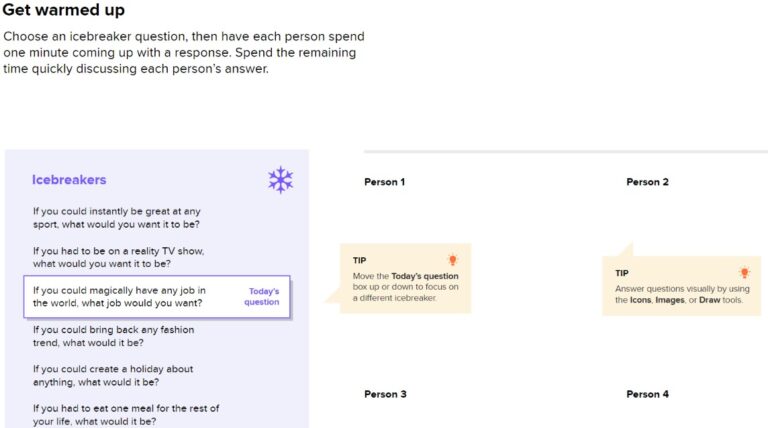
Figure 1.0 – Ice Breaker with 21 questions to get the team warmed-up and know each other.
What is the mural app and how can it be used to increase team productivity?
Whether starting with a blank Mural or building off one of the many existing templates, anyone can easily create Murals for various purpose: brainstorming, storyboarding, team retrospectives, strategic planning, training, as such. Teams can also take part in real-time online discussions around projects, making everything more interactive. These workspaces are designed so they are easy to share – meaning teams can participate as anonymous visitors in a Mural without requiring any paid license. While other collaboration tools usually require a paid license to be able to participate in the collaboration board. Once all the work is said and done, the content can be downloaded and shared as a pdf or image.
Figure 2.0 – Quick check-in to get participants to focus and learn the Mural activity.
What makes Mural unique is that it comes with a number of build-in features. For example, users can choose from a library of icons, photos, and frameworks. If you are feeling creative, you can simply draw in the drawing section to create visuals that communicate ideas effectively. The tables feature makes it easy to organize content into columns and rows, while the framework feature allows the quick creation of industry-standard templates to be embedded into the Mural. The content library allows users to quickly save and repurpose images, texts and import files for future use as well. All these features make the workspaces easy to navigate and can be created into aesthetically pleasing forums. While other collaboration tools also have some templates and other build-in functionalities, Mural has pioneered the collection of templates by opening up to contributors beyond just the Mural team.
Figure 3.0 – Team Retrospective provide by Mural
The benefits of app.mural.co for facilitators and participants
With easy sharing capabilities, your organization can quickly and seamlessly get everyone in the same room onboard with what is happening even if they are miles apart. For participants, the Mural becomes an interactive medium where everyone can have a voice. It brings teams, or teams of teams, together synchronously and asynchronously. In addition, some Mural sessions can have multiple templates to support breakout sessions. Participants can work together in their own work areas, while having visibility to the other teams’ work. This is great if you need to share your work across multiple teams. This supports divergent and convergent activities that happen during prioritization, design thinking, and architecture design.
Mural offers facilitators of remote or hybrid teams an array of features that help bring teams together. With Mural’s voting feature, facilitators can easily gauge the opinion of team members on different ideas and solutions, allowing for effortless group decision-making. The outline feature allows facilitators to hide, display, and focus on the most important topics. The summon feature allows facilitators to guide mural participants to navigate to the appropriate section or topic. Facilitators can also share content with both members and visitors, downloading and sharing all content with ease. Private mode is available too, allowing participants to provide input anonymously. Facilitators, along with participants, can provide comments on edits and feedback – providing multiple ways to communicate effectively within teams. All these functionalities make it easier than ever before for teams to collaborate, work together, and document feedback with higher efficiency while having fun at the same time.
In conclusion
There are a myriad of options when it comes to online collaboration tools, with Mural as one of InBiteSize’s top choices. It is a cost-effective and easy to use tool. Its visual appeal makes it engaging for all involved, while its accessibility ensures everyone can use the platform with ease. With features such as brainstorming, design thinking, ice breakers, diagramming, and hosting virtual events, Mural offers a range of functions to help teams work together productively. Whether you’re looking for a way to collaborate more effectively or just want some fun in the workplace, Mural should definitely be your go-to choice! What are you looking forward to using Mural for? Contact us if you need help.
Welcome to the first part of our Collaboration Tool Series, where we give you a play-by-play of the various platforms in the market.
I’m sure we can all agree that the events of 2020 have changed the way we live and work. One of the biggest changes has been the move to virtual collaboration tools- whether that is via Miro,Mural, Microsoft Whiteboard, or any other alternative.
For some of us, this has been a huge adjustment. We’re used to pulling out stacks of post-it notes and piles of sharpies, and now we hope folks are clicking away at their desktop and throwing us a few reactions so that we know that they are following along.
You might be tired of hearing sales pitches from each of the platforms, so we’re here to give you our unbiased opinion. Here’s a quick breakdown of Miro.
Introduction to collaboration tools
Just like its competitors, Miro is a collaboration tool that facilitates interactive whiteboards, project management, and brainstorming. It enables teams to create dynamic visual frameworks and collaborate in real-time on documents, sketches, diagrams, and mockups. Adaptable for multiple use cases, Miro can be used for collaboration projects, product roadmap planning, UX/UI design, workshop facilitation, and more.
Miro provides a simple, intuitive interface for teams to quickly create beautiful designs and collaborate on them in real-time. It has the standard array of features, which includes the ability to add images, videos, and audio files as well as sticky notes, text boxes, and retrospectives.
Benefits of Miro
Miro shines through its huge selection of templates in its Miroverse marketplace, where solutions like brainstorming frameworks, customer journey mapping kits, and launch campaign checklists are available at your disposal. If you wanted to try your hand at publishing, it is easy to submit a template and get your name out there.
In addition, Miro has several features that are already built-in into its product. From running a timer to leveraging its estimation app, you have everything you need to facilitate an effective and engaging workshop.
Miro also offers an incredible range of integrations with other popular tools like Google Drive, Slack, Zoom, Jira, and more. With these integrations, teams can easily transfer data between platforms as needed. (Just think, you no longer need to update Jira and Confluence and Miro and, and, you get the picture).
With these plugins, companies of all stages are using Miro as an all-in-one collaboration space.
Where the competitors win
When it comes to products in the market, competitors need to offer more than just a multitude of integrations to stand out. Unfortunately, everyone will need a license even if they want to view your Miro. There’s no easy way to share the outcomes of your team’s last meeting unless you take a screenshot and hope that it is not too blurry.
For others, it may help that the tool has built-in templates that support their implementation of the Scaled Agile Framework. That way, they do not need to surf through the thousands of templates in the Miroverse and instead, simply click a button or two and the template matches the framework.
Though it may be easier said than done, having effective meetings with others is more important than ever in a virtual world. It can be difficult to transition from in-person to online collaboration, and luckily there are various platforms such as Miro that help smooth transitions and meet the challenges of a highly remote workforce. The benefits of Miro allow for creative thinking, better engagement with teammates, and overall success in a virtual setting. While the competition might have an edge when it comes to certain areas, considering how you want to engage with your teams and beyond. Ask yourself–what are the minimum features you need to get started?
ByRochelle Tan
July 24, 2023 Tools & Templates
Mural is a digital workspace that helps distributed teams come together and get work done. What makes it effective is that it’s simple, easy to use, and visually… Read More
ByCassandra Chew
July 7, 2023 Tools & Templates
Welcome to the first part of our Collaboration Tool Series, where we give you a play-by-play of the various platforms in the market. I’m sure we can all agree that the events of 2020 have… Read More
ByCassandra Chew
May 10, 2023 Lifestyle
Hello, there! I’m Cassandra. Rochelle and I are pleased to present to you InBiteSize. Before we get into the nitty gritty of the world of transformation, we figured it would be a good idea for you to… Read More
ByRochelle Tan
April 19, 2023 Book Review,Reviews
Ever wonder how something goes viral? What makes something so infectious? I am not mainly referring to a disease or a virus, but more on the lines of ideas or trends. Often we hear something or… Read More
Hello, there! I’m Cassandra. Rochelle and I are pleased to present to you InBiteSize. Before we get into the nitty gritty of the world of transformation, we figured it would be a good idea for you to get to know us. That way you know where we’re coming from and have the context to apply our tools of the trade to your own world. In fact, as Brené Brown, one of my favorite authors, puts it, “Vulnerability is the core, the heart, the center, of meaningful human experience.” We are here to give you a glimpse into our hearts so that we can connect with you well beyond the words typed onto these pages.
So first, why should you read our blog?
We’re cool people.
We’ve been in the field.
We’re secretly lazy inside.
We’re cool people.
Need someone to join you on the dance floor? Sing a duet with you on karaoke night? Break the awkward silence with the most work appropriate joke? Meet Rochelle Tan. Frankly, she is able to balance this all, while still managing a busy household and herding her various clients. Plus, she has also been a Yelp Elite since 2015, so she’s an expert on giving you just the right amount of information to help you move forward.
Personally, I excel at giving you the most maximist travel itinerary and thinking of the most creative way of engaging folks at work. I promise you that I’m not bragging. My Paris, France google map has been viewed over 200+ times. (Just leave a comment if you’re interested in seeing it. I also have one for Portland, London, and the various Hawaiiian islands).
Also, some of my favorite compliments from work include, “You should host your own game show,” and “I didn’t think we would be able to plan for all the requirements and have fun at the same time.” My philosophy is that if I’m going to be working for eight hours and facilitating all of your ceremonies and workshops, it better be at least worth my time if not yours, too.
We’ve been in the field.
Now on to the serious portion of this post… Rochelle and I met back in 2019. During that time, our company learned that they did not want to be in the business of running data centers. Therefore, they quickly formed tiger teams to figure out how we could move to the cloud. Through trial and error and a bit of coaching, we partnered with other thought leaders to build a successful blueprint that could be adapted to fit the unique needs of each of our teams.
Beyond that, Rochelle and I have 30+ years of combined experience. We have been in a number of different industries ranging from Energy to Gaming to BioTech and in a number of different roles from Business Analysts to Digital Consultants to Agile Coaches and beyond. In each of these roles, we have formed and led coalitions of change agents to drive meaningful change throughout our organizations. We focus on meeting folks where they are, whether they are just starting out on their own evolution or cultivating an environment where their teams can thrive.
And finally, we’re secretly lazy, we mean, highly effective people.
Rochelle has two tweens to juggle, and I’m the godmother of a French bulldog named Mr. Darcy. Between balancing her kids’ hockey schedules and me trying to eat and hike my way through the Bay–along with trying to buy a house and plan a wedding– there is sometimes not enough time in the day, or week, to get things done. We get it. Instead of sifting through books, attending days-long conferences, and finding the right energizer for your next virtual meeting, we are here to give you the best information in bite sized chunks.
So that’s it. That’s why we are here. We truly appreciate you stopping by and joining us on our journey. As you leave us today, here is something for you to ponder, “We are born makers. We move what we’re learning from our heads to our hearts through our hands.” So, what are you interested in shaping with us?