Welcome to the second installment of our “Is Agile Dead” blog series. After exploring the importance of the agile mindset for organizations to achieve business agility, this post delves deeper into the transformation from merely “doing Agile” to truly “being Agile.” It highlights how the diverse Agile frameworks, specifically Scrum, have evolved to uphold the core intent of the twelve principles outlined in the Agile Manifesto. By embracing this mindset, organizations can foster innovation, collaboration, and adaptability, while ensuring they remain responsive to ever-changing market demands. Join us as we unpack the journey from procedural adherence to an Agile culture shift.
The 12 Principles of the Agile Manifesto and Their Tactical Implementation
The Agile Manifesto presents twelve core principles that underpin Agile frameworks. We’ll delve into these twelve principles, emphasizing practical implementation and intended outcomes. To maintain InBiteSize standards, on keeping things short and digestible, we will divide the discussion into two parts.
Part 1: Principles 1 to 6
1. Customer Satisfaction through Continuous Delivery
Principle: Our highest priority is to satisfy the customer through early and continuous delivery of valuable software.
Intended Outcome: High levels of customer satisfaction and trust.
Tactical Implementation: Implement frequent delivery cycles, sometimes known as sprints, to ensure early and continuous software deliveries. By prioritizing the most valuable features, teams can provide customers with functional increments sooner, gathering valuable feedback to refine and improve the product continuously.
2. Welcome Changing Requirements
Principle: Welcome changing requirements, even late in development. Agile processes harness change for the customer’s competitive advantage.
Intended Outcome: Increased adaptability and responsiveness to customer needs.
Tactical Implementation: Incorporate change management processes and tools that allow for real-time adjustments. Maintain a flexible backlog that can be updated with new requirements as they arise, ensuring the product evolves to meet the latest customer demands.
3. Frequent Delivery of Working Software
Principle: Deliver working software frequently, from a couple of weeks to a couple of months, with a preference to the shorter timescale.
Intended Outcome: Regular delivery of incremental value.
Tactical Implementation: Set up a structured sprint cycle, usually lasting 1-4 weeks, and schedule regular sprint planning and review meetings. This rhythm ensures frequent releases and maintains a clear focus on delivering working software at each iteration.
4. Collaboration Between Business and Developers
Principle: Business people and developers must work together daily throughout the project.
Intended Outcome: Enhanced communication and mutual understanding.
Tactical Implementation: Foster daily interactions between business stakeholders and development teams, by using tools like daily stand-ups or collaboration software. This close cooperation ensures that both sides are aligned on priorities and project goals, leading to more effective solutions.
5. Motivated Individuals
Principle: Build projects around motivated individuals. Give them the environment and support they need, and trust them to get the job done.
Intended Outcome: High team morale and productivity.
Tactical Implementation: Create an empowering environment where team members feel valued and supported. Invest in professional development opportunities and encourage autonomy in decision-making to foster intrinsic motivation.
6. Face-to-Face Conversation
Principle: The most efficient and effective method of conveying information to and within a development team is face-to-face conversation.
Intended Outcome: Clear and efficient communication.
Tactical Implementation: Whenever possible, encourage in-person or real-time virtual meetings to discuss project details, as these interactions promote clarity and quick problem resolution. Utilize video conferencing tools to maintain this practice even for remote or distributed teams.
Transitioning from “doing Agile” to “being Agile” demands a profound commitment to embracing the principles of the Agile Manifesto. By strategically implementing these principles, teams can cultivate a genuine Agile mindset that boosts efficiency, fosters collaboration, and enhances customer satisfaction.
How has your team applied these agile principles into your value delivery framework? Ready to revolutionize your team’s approach to work? Schedule a call with one of our agile delivery consultants and embark on your transformational journey towards accelerating value delivery and growth.
Feeling like your goals are galaxies away and your to-do list is a monster you can’t slay? Yeah, me too!
But listen up, because I’m about to share a secret weapon that I discovered, a hidden gem from the world of project management that can transform your daily routine: The Daily Stand-Up.
Now, hold on a sec. You might be thinking, “Isn’t that some techie thing with people in hoodies huddling around a whiteboard?” Nope! We’re about to unleash the power of the Daily Stand-Up for your life goals.
Imagine you’re the CEO of Your Amazing Life Inc. You have these incredible goals and multi-million dollar projects that you’re determined to see through.
So, how does this Daily Stand-Up for Life Goals work? It’s surprisingly simple, and the best part, it only takes 5 minutes of your precious morning. ⏰
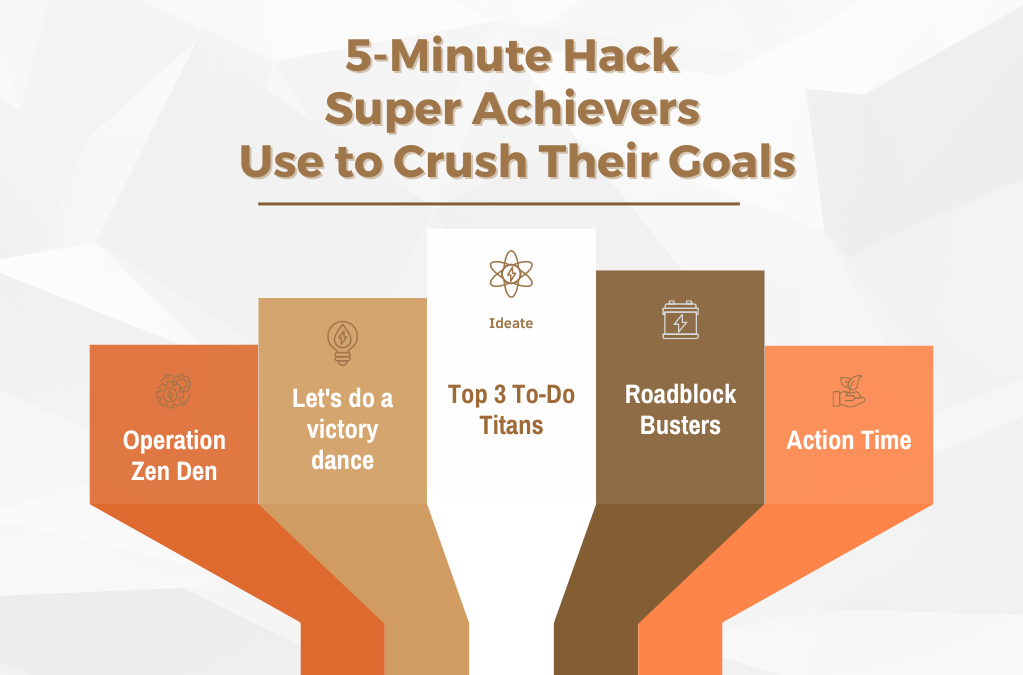
Operation Zen Den
Think of it like this: You wake up, grab your coffee or tea, and find your own little zen den – a quiet corner (physical or mental) where you can escape the morning chaos. Grab your notebook, phone, or just a quiet corner in your mind. Dedicate these 5 minutes to focusing on yourself and your goals. Escape the morning chaos and create your own mini-productivity sanctuary.
Let’s do a victory dance!
Start by acknowledging your victories from yesterday, no matter how small they may seem. Did you conquer that extra 10 minutes on the treadmill? Or finally finish that chapter of the book that you’ve been meaning to read for ages? Give yourself a mental high five for these accomplishments! Celebrating progress, big or small, fuels motivation – like a pat on the back for good behavior (think positive reinforcement!). The more you celebrate, the more you’ll keep achieving.
Top 3 To-Do Titans
Now, identify the three(3) most important things you want to achieve today that will move you closer to your long-term goals. These are your “Top 3 To-Do Titans” – the tasks that will make the biggest impact on your mission. Maybe it’s tackling a specific step on your side-hustle, finally starting that meditation practice, or simply saying “no” to a commitment that doesn’t align with your priorities.
Roadblock Busters
But wait! There’s always a villain lurking and ready to trip you up. Maybe it’s that afternoon slump that hits you like a ton of bricks. So, be a superhero and anticipate those roadblocks!
Feeling tired? Schedule a quick walk break to recharge your batteries. Having trouble focusing? Block out dedicated “deep work” time where you silence distractions and dive headfirst into your task. Think of yourself as a superhero, anticipating the villain’s schemes (aka procrastination) and coming up with a foolproof plan to foil them!
For example, let’s say email overload is your kryptonite. During your Daily Stand-Up, brainstorm solutions like batching your responses or utilizing a “Do Not Disturb” setting during deep work periods.
Action Time!
With a clear plan and a positive mindset, get ready to take action! This is your official launch into a productive and goal-oriented day.
The Daily Stand-Up Advantage:
This simple 5-minute ritual unlocks a treasure trove of benefits:
Celebrating progress, big or small, keeps you moving forward. Psychologists agree – positive reinforcement is key to building habits and achieving long-term goals.
By verbally committing to your goals (even if it’s just to yourself!), you’re more likely to stick to them. The Daily Stand-Up is your daily check-in with your CEO self (remember, you are the CEO of Your Amazing Life Inc.!). Are you on track?
Agile for Everyday Life: Beyond the Daily Stand-Up
The Daily Stand-Up is your springboard. Agile offers even more tools. Conquer your kitchen with Kanban boards (visual meal planning!), or master a new skill with iterative learning. Set small goals, adapt as you go, and crush them!
Ready to become your own superhero?
Incorporate the Daily Stand-Up into your morning routine and unleash the power of focus, motivation, and goal achievement.
Remember, consistency is key. Even a small, 5-minute investment each day can create a ripple effect of positive change in your life.
Who else is ready to conquer their day?
Ready to conquer your day? Incorporate the Daily Stand-Up into your routine and share your experience using #DailyStandUpForLifeGoals and explore InBiteSize’s other resources, like our book review on Atomic Habit or The Disruption Mindset, to become an Agile master in all areas of your life.
I don’t know about you, but whenever I see an aesthetically beautiful presentation, the presenter instantly gets my attention. Of course, there’s more to an effective presentation than its looks. However, I trust that you have your own experience and/or domain experts on your side to ensure your content is worthwhile. The hard part is making your content stick, and as a consultant, it should be your goal that your participants walk away with actionable steps. In today’s blog, we’re going to introduce to you Canva, a freemium graphic design powerhouse to help you, help your organization.
By background, I am a software engineering professional to the core. The only content that I created before being introduced to Canva were slides for meetings and the occasional flyer to advertise an upcoming event. On top of that, my experience with graphic design was whatever I could muster with the smart diagrams and clip art found in Microsoft PowerPoint and Google Slides. Therefore, I’m probably missing out on a lot of capabilities that Canva has to offer, and I won’t do this platform justice…
However, we want you to swallow any fear or anxiety you may have and dive right into this world of graphic design with us. The good thing is that Canva is easy to get started with and has a great user interface. So, today, we will highlight how we have used this platform to generate workshops, publicize events, and tell a story to inspire innovation, engagement, and creativity.
Generate Workshop
As a freemium tool, Canva has a mixture of templates, graphics,and layouts for basically any use case from teaching a concept to pitching a product to playing a game. In most cases, the free version is enough. You’re able to use a good number of layouts and elements and share your content across your organization.
In our case, we often use the presentation template to generate content for our workshops. First, we choose a theme like “minimalist design” or “technology startup.” After that, we add our content just like we normally do for a PowerPoint presentation. Like the other tools on the market, you’ll be able to share your content with your peers so that they can edit it with you. Finally, we leverage Canva’s flairs, such as its library of elements that includes graphics, photos, videos, and more to tie our presentation together. The cool part is that once you select a particular thematic element, like plant imagery to reflect growth, its AI capabilities will suggest similar items for you to include in your presentation. From there, you’re free to present within Canva or download it as a pptx or pdf file. Note that when you download it, you might lose some of Canva’s features. However, its presentation mode is very similar to Powerpoint’s in which you can add timings and see your speaker notes.
In addition, one of the benefits of upgrading to Pro is that you can import your organization’s brand toolkit. This comes in handy if you want to replace the colors of its out-of-the-box graphic or slide layouts with your own. That way you can tailor the layouts to fit your needs and create a sense of consistency as you move from one project to the next.
Publicize Events
Now that you have your workshops created, you’re probably thinking about how you’re going to advertise it. Canva has an answer for that with its wide range of social media designs that can be shared on Instagram, Facebook, and Linkedin. Beyond that, it also has designs for print, which include flyers and posters.
Recently, we hosted an Objective Key Results workshop and wanted to generate buzz and excitement. We leveraged Canva’s LinkedIn Video ad templates to create a 30 second animated ad. Once we figured out our content, it only took us one hour to put it together. First, we searched for designs that were centered around teaching and education. After that, we changed the content to match our context. Finally, just like we did for the workshop itself, we replaced the elements to match our workshop’s theme. Voila. We had an engaging video that highlighted the workshop’s details and benefits. It could also be shared across all our social media platforms with ease.
When making ads, it may come in handy to unlock some of Canva Pro’s features. For example, you will need Pro if you want to change the audio. You’ll also need the upgraded version to download your creation as a mp4.
Tell a Story
As you read in our previous use case, Canva shines because it allows us to tell a story by building upon a theme. Each of its capabilities, from logo creation to personal uploads to its brand toolkit, lets you create a seamless experience for your co-collaborators and your audience.
For example, one of our favorite use cases of Canva was when we used it to throw an innovation week for our organization. Our theme for the week was to develop something that was “out of this world.” We created our own space theme logos and used them in our presentations and flyers. Each day our team was excited for the morning report, and we had the most teams participating ever.
In another use case, we were creating the pitch for our organization’s internal hackathon. For our hackathon, we were showcasing the power of OpenAI models to create a chatbot to support our internal users. My organization is a gaming company, and Canva had the perfect video game themed design for us to tell our story. We used Canva’s existing graphics to show how our protagonist leverages the power of AI to automate our help desk. Although we didn’t win, we received a lot of praise for our video.
Engage your audience today
In conclusion, Canva is the perfect tool for your day-to-day employee to get started with graphic design. With its collection of templates and graphics, you’ll be sure to find something that fits your needs. However, remember, a tool is only as good as the content you have, so use Canva with caution. Don’t go overboard with all the neat offerings and forget your goal: to empower your teams to be the best they can be. Do experiment and get feedback on the features that your audience appreciates. And, if you’ve found a special trick, be sure to comment below. We are still unlocking all it has to offer, too.
Want to learn about the other tools we have in our toolkit? Check out our articles on Kintone and Confluence. Need to work on your mindset instead? Check out our review on Multipliers & Drive.
The question of whether Agile is dead has sparked significant debate recently. Before diving into this topic, let’s first consider why many organizations transitioned from the traditional Waterfall methodology to Agile in the first place.
Why did companies move from Waterfall to Agile?
The shift to Agile was driven by the need for business agility. To stay relevant in today’s fast-paced market, businesses must quickly develop and mature innovative products, requiring a cultural shift in strategy and operations. The long delivery cycles of the traditional Waterfall methodology hinder an organization’s innovation strategy. While Waterfall isn’t entirely obsolete, delivering innovative products is better achieved with an Agile approach, which allows for value delivery when customers need it (or just moments before they realize they need it). Developing such products requires an environment that encourages risk-taking and views failure as an opportunity to learn and grow. This fosters the business agility needed to quickly learn, adapt, and accelerate value delivery.
Business agility refers to an organization’s ability to adapt quickly and efficiently in response to market changes. It involves fostering a culture of constant innovation, adaptability, and continuous growth.
What is the problem then?
Recently, some have claimed that Agile is dead. This sentiment often stems from a misunderstanding of what Agile truly represents. Many view Agile as a methodology or process, but it is more accurately described as a mindset. Methodologies come and go, usually defined by a set of rules and steps that teams must follow, giving an impression of rigidity. A misstep can lead to issues or non-delivery.
This article will delve into the meaning of methodologies and mindsets, the relationship between the two, and the importance of recognizing Agile as a mindset rather than a methodology.
Agile as a Mindset
Limiting Agile to a mere methodology is a narrow perspective. At its core, Agile fosters a culture of innovation, adaptability, and continuous growth. It fundamentally reshapes how teams think, act, and make decisions. Unlike rigid methodologies, Agile is a mindset that informs the development of frameworks, processes, and methodologies to enhance business agility.
Innovation
Encourages creative solutions and new ideas. It provides space for team members to focus on their work, experiment with new concepts, and rewards unconventional thinking because risk-taking is the norm.
Adaptability
Embraces change and enables rapid adjustments. While processes help align the organization, decentralizing decision-making is prioritized to empower autonomous teams, thereby increasing organizational accountability and responsiveness.
Continuous Growth
Emphasizes constant improvement and learning. Recognizing that building innovative products and services carries a higher risk of failure, which is viewed as an opportunity for growth and learning.
The agile mindset is achieved by embracing its core values rather than relying on tactical methods. These values include:
Individuals and interactions over processes and tools
working software over comprehensive documentation
Customer collaboration over contract negotiation
Responding to change over following a plan
What Agile is Not
Agile should not be mistaken for a process, methodology, or company policy. It is a way of working and thinking that permeates the organization. Unlike defined methodologies, which can be changed through policies and playbooks, a mindset is foundational and takes time to become ingrained. It becomes part of the team’s and organization’s culture.
Methodology vs. Mindset
Methodologies are more tactical and process-focused, while a mindset embodies the core principles guiding every team member’s and leader’s behavior and decisions.
Methodologies are well-defined and specific, whereas a mindset is abstract and encompassing.
Methodologies can change easily, but a mindset is long-lasting and foundational.
In simpler terms
As organizations progress in their agile journey, they may develop frameworks and models to boost agility. These can be translated into methodologies and playbooks. Each organization can tailor these variations for effectiveness. The core agile values and principles persist as an agile mindset.
Assuming that an organization can foster an innovative culture without embracing an agile mindset is akin to:
Raising a child by merely providing food, shelter, and clothing, while neglecting their cognitive, mental, and emotional development.
Running a business solely to survive, without any strategy or growth plan.
Delivering a speech that is devoid of purpose or conviction.
A painter creating art with no emotion or meaning.
Writing a grammatically perfect novel that lacks a compelling plot or message.
Looking into the Future
This article is the first in a series that will explore Agile values, explained through its 12 principles.These principles encapsulate what it means to fully embrace an Agile mindset, setting a foundation for future discussions and deeper understanding. Stay tuned as we delve into how you can harness these principles to empower your organization, accelerate value delivery, and drive sustained success.
Principles behind the Agile Manifesto
1. Our highest priority is to satisfy the customer through early and continuous delivery of valuable software.
7. Working software is the primary measure of progress.
2. Welcome changing requirements, even late in development. Agile processes harness change for the customer’s competitive advantage.
8. Agile processes promote sustainable development. The sponsors, developers, and users should be able to maintain a constant pace indefinitely.
3. Deliver working software frequently, from a couple of weeks to a couple of months, with a preference to the shorter timescale.
9. Continuous attention to technical excellence and good design enhances agility.
4. Business people and developers must work together daily throughout the project.
10. Simplicity–the art of maximizing the amount of work not done–is essential.
5. Build projects around motivated individuals. Give them the environment and support they need, and trust them to get the job done.
11. The best architectures, requirements, and designs emerge from self-organizing teams.
6. The most efficient and effective method of conveying information to and within a development team is face-to-face conversation.
12. At regular intervals, the team reflects on how to become more effective, then tunes and adjusts its behavior accordingly.
In today’s fast-paced business landscape, seamless teamwork and data management are the keys to conquering any project. From streamlining project workflows to breaking down communication barriers, tools that empower your team have transformed the modern business landscape. Let’s turn the spotlight on to Kintone, an application platform that has brought a fresh approach to the world of collaboration. While others have drowned in a sea of spreadsheets and games of telephone, Kintone has stepped up to the plate as a no-code platform that unlocks your team’s potential today.
The Rise of No-Code Tools
The no-code revolution is currently reshaping the business environment, democratizing the creation of custom applications. Platforms like Kintone bring this power into the hands of the non-coders, equipping employees of all levels with the ability to create apps that streamline workflows and enhance teamwork.
Enter Kintone: The Drag-and-Drop Platform
Kintone is a cloud-based platform designed to simplify the construction and deployment of custom applications. With its drag-and-drop interface, it frees individuals from the realm of complex coding languages, enabling them to create apps that can automate tasks and facilitate collaboration.
Understanding Kintone's Potential in Action
Let’s delve deeper into how Kintone empowers various teams:
HR Departments: Imagine an HR department drowning in a sea of spreadsheets from employee onboarding to performance reviews to leave requests. Kintone offers a streamlined solution. They can build a custom HR application to streamline the entire process. This application can track new hire information, required documents, like qualification checklists and training material links, training completion status, and even include a discussion section for manager feedback. Kintone’s built-in approval workflows can automate the onboarding process, saving HR valuable time and ensuring a smooth transition for new employees.
Sales Teams: Sales teams can leverage Kintone to manage customer interactions, track leads like a hawk, and collaborate on proposals within a central hub. Imagine a sales application that houses customer contact information, tracks lead stages (think “cold” leads turning “hot”), and allows for real-time collaboration on quotes and proposals. In addition, Kintone’s mobile accessibility empowers sales teams to access crucial data and collaborate with colleagues on the go, which allows them to close deals faster and stay ahead of the competition.
Marketing Teams: Marketing teams can utilize Kintone to streamline campaign management, content creation, and social media scheduling – no more social media black holes! For example, they can create a centralized application to track campaign progress, manage content calendars, and assign tasks to team members. Kintone’s built-in communication features, like discussions and comments, eliminate the need for endless email threads and foster a collaborative environment for successful marketing campaigns that produce stellar results.
Key Features and Benefits of Kintone
Kintone’s appeal lies in its simple yet powerful features:
No-Code Accessibility: Anyone can build custom applications, democratizing app development and allowing teams to create solutions without relying on IT.
Centralized Hub for Teamwork: Kintone fosters seamless teamwork by housing project details, discussions, tasks, and updates in one location. This eliminates information silos and streamlines communication.
Data Visualization for Informed Decisions: Kintone helps gain valuable insights from data through built-in charts and graphs. For example, marketing teams can leverage this to analyze social media campaigns and optimize their strategies.
Granular Security Controls for Peace of Mind: Data security is paramount. Kintone offers granular permissions, allowing you to control who sees and interacts with specific information within each application. You can define user roles and permissions with great precision, ensuring that sensitive details are secure while still ensuring everyone has access to the data they need to perform their jobs effectively.
Deep Dive into Kintone's Advanced Features
In addition to its baseline functionality listed above, Kintone offers a rich set of features:
Streamlined Workflows with Automation: Kintone allows you to automate repetitive tasks and workflows, freeing up valuable time for your team to focus on more strategic initiatives. You can set up automated triggers and actions based on specific criteria. For instance, an HR application could automatically send a notification to a manager when a new hire completes their onboarding paperwork, eliminating manual reminders and ensuring a smoother onboarding process.
Mobile Accessibility for On-the-Go Collaboration: The Kintone mobile app allows team members to access important data, collaborate on tasks, and stay updated on the go. This ensures that projects move forward even when team members are outside the office, promoting flexibility and agility. For example, imagine a sales team on the road being able to access customer data, update lead statuses, and collaborate on proposals in real-time using the Kintone mobile app. The app keeps everyone connected and fosters a productive work environment regardless of location.
Integration Potential for a Unified Ecosystem: Kintone integrates with various popular business tools and services, allowing you to connect it seamlessly with your existing workflow. This eliminates the need for manual data entry and ensures consistency across different platforms. For instance, you can integrate Kintone with your CRM system to ensure customer data is always up-to-date and readily accessible within your Kintone applications.
Revision History and Audit Trails for Transparency: Kintone keeps a detailed record of all changes made to data within applications. This ensures transparency, facilitates troubleshooting, and allows you to track data modifications. This can be crucial for regulatory compliance or simply ensuring everyone is on the same page regarding the latest updates within an application.
Kintone and the competition: Choosing the Right Platform
For example, Kintone and Microsoft Power Apps are both powerful tools, but they cater to different needs. Kintone excels in user-friendliness, making it ideal for teams with limited coding experience. Power Apps offers extensive customization options, allowing for the creation of highly complex applications. Consider these factors when making your choice:
Technical Expertise: If your team has limited coding experience, Kintone’s user-friendly interface is a strong advantage.
Customization Needs: Highly complex applications might be better suited for the robust customization options offered by Power Apps.
Existing Software Ecosystem: If your organization heavily relies on Microsoft products, Power Apps might provide a smoother integration experience.
Teams with less technical expertise who desire a platform that’s easy to learn will find Kintone a viable option. However, if you are looking for deeper integration with your in-house tools and extensive customization options, you may find products, like Microsoft’s Power Apps, a more fitting choice.
In the end, it’s about selecting the right tools for your team–one where you feel more connected and motivated to work together towards a common goal. After all, great teamwork breeds success!
Curious to learn about other tools to support your team? Check out our article about Mural.
Peering into the looking glass of artificial intelligence (AI), we’re often cautioned about the “hallucinations” that Language Learning Models (LLMs) might produce. And yes, while it’s a concern worth acknowledging, I’m here to guide you through a compelling argument that LLM hallucinations, often decried, aren’t all that bad. In fact, they might just be the yin to the yang of AI’s capabilities.
Unveiling the Facets of LLM Hallucination
Before we decry the concept altogether, it’s crucial to understand what LLM hallucinations are. LLMs can produce text that carries meaning, but that doesn’t mean it’s always accurate. The difficulty lies in LLMs’ learning processes, which consist of predicting and approximating sentence structures without truly ‘understanding’ as humans do. Consequently, they may inadvertently usher “hallucinations” into their output, which are difficult to differentiate between insight and illusion.
The Implications We Can't Ignite
We’ve seen the ripples of these hallucinations, which sometimes cause tidal waves of disruption. Consider Google’s chatbot, Bard, live launch event where an erroneous output/response led to a $100 billion tumble in the tech giant’s stock value (see article for more information).
In another instance, a court case resulted in the plaintiff lawyer’s “fall from grace” influenced by a 10-page brief filled with fictitious legal precedence generated by ChatGPT (see article for more details). These scenarios are but a few examples from a long list of misleading occurrences attributed to AI hallucinations.
The Unspoken Advantages of AI's "Hallucinations"
For every misstep, there’s a stride—an innovative step forward. AI’s “hallucinations” can inject creativity and novelty into its output by threading together responses that human logic might not fathom. But it doesn’t end there. These figments can also fill in gaps in information with astonishing coherence and generate content that does not aim for precision or accuracy but somewhere within the lines of intuitively correct and engaging. Below are a couple of examples to ponder on:
Entertainment – Take a playwright for instance. He or she may be looking for wild ideas that can transform into a compelling story that plays on the border of fiction and reality. The objective is to make it convincing enough for the audience to accept the plot as a plausible occurrence, yet provide enough novelty to trigger the senses through the unexpected.
Beyond entertainment and engagement, hallucinations can be used as a tool to minimize, if not prevent, hallucinations. Encountering and analyzing hallucinations in outputs can be valuable for researchers and developers as they work to improve AI models. Understanding the conditions under which hallucinations occur can help in developing more robust and reliable systems.
The Parrying of Potential Pitfalls
Acknowledging the tightrope walk, AI navigators face is crucial. To mitigate the risks of hallucinations, strategies such as retrieval-enabled models, self-consistency checks, and prompt engineering stand at the forefront. These guardrails steer the AI’s course back to accuracy and away from the edge of misinformation. Here are some strategies to take to improve the LLM’s accuracy or trustworthiness:
Retrieval-enabled models – These are models that first retrieve relevant data or documents from various sources and use the information to inform their LLMs response. This grounds the responses on retrieved (relevant) data instead of the output being based purely on patterns in the training data.
Self-consistency checks – This method involves the generation of multiple answers to the same question from the model. The idea is that a correct and reliable response will be consistently produced across different compositions of the same question or even varied internal parameters of the model.
Prompt Engineering – This involves carefully formulating the input or ‘prompt’ given to the LLM to elicit the most accurate and relevant information. This can include structuring the prompt to reduce ambiguity, leading the model with specific instructions or framing the questions in a way that encourages the model to access the most relevant parts of its knowledge.
Harnessing the Benefits, Avoiding the Downside
If used wisely, AI-generated content could be the ‘secret sauce’ for creativity in industries that face the brunt of routine and rigidity. However, given the current state and nature of training LLMs – data used to train LLMs come from various sources, usually the web, which can contain facts, embellished, fake, biased, and myriad of information – it would be prudent to say that the content they produce will require some level of human verification or oversight to harness AI’s potential without succumbing to its pitfalls.
Opinion pieces can often be read as warnings against the potential hazards of new technologies. However, in the nuanced world of AI, it’s imperative to also appreciate the shades of gray. By utilizing the creative and insightful capabilities of Large Language Models (LLMs), we can envision a future where AI serves not only as a repository of knowledge but also as a collaborative partner in shaping human narratives.
This doesn’t mean we should forget the human touch that helps us tell facts from fiction. Actually, it’s the opposite. It’s like we’re being invited to strengthen our bond with AI, so we can keep learning from it and make sure it learns from us too.
Diving into the paradoxical world of LLM hallucinations? I’m turning the spotlight on you! What’s your take on the benefits and uses of LLMs in your world? On the other side of the coin, what wise strategies should we employ to navigate past those deceptive “hallucinations”? How can we equip ourselves with the knowledge and insight to see beyond the facade and make informed decisions that propel us forward? Your thoughts are the gold we need to map out this wild AI journey. So, drop your insights below or hit us up on your go-to social spot. Let’s keep this crucial conversation rolling!