In this episode, we have InBiteSize’s very own Ginny Sikri, a Program Manager active in IIBA and PMI, provide a perspective on how to build successful teams based on her book review of Patrick Lencioni’s “The Five Dysfunctions of a Team.”
Elements of the Episode
Key takeaways from the book
Why teams struggle
How to build trust through Ginny’s 3 C’s
Ginny Sikri is an experienced Program Manager with a robust background in driving complex initiatives and promoting innovation within the technology and finance industries. Her career highlights include launching AI-driven SaaS products, Digital Banking transformations and the delivery of intricate solutions across multiple countries.
At @InBiteSizelearning , we believe in the power of information. We want to help people, like you, learn everything from best practices to the latest changes in the industry so that you can build a high performing team.
Follow us on Spotify and Amazon Music: @InBiteSize
Is your organization struggling to consistently deliver products and services? Does bureaucracy impede your decision-making process? Are you encountering obstacles in getting things done? Are these questions too close to home? Then, it may be time to reassess and rejuvenate your ways of working. Many traditional organizations suffer from these issues, leading them to be outpaced by competitors. This is because they lack the business agility to respond and operate effectively in today’s very demanding market.
Implementing Agile in your business can be transformative since it offers flexibility, faster value delivery, and enhanced customer satisfaction. However, challenges can arise. In this blog post, we’ll share practical strategies to navigate these hurdles and finish it with a real-world success story that highlights the power of Agile transformation.
Understanding Agile and Its Importance
Why is Agile Important?
Organizational agility allows your business to:
Accelerate Value Delivery: Swiftly deliver products and services that align with your customer’s needs.
Deliver the Highest Value: Provide exactly what customers want, precisely when they want it.
Build Quality In: Integrate quality into every step of the development process.
What Does It Mean to Be Agile?
Being Agile is not just about adopting new practices; it is about fostering a mindset defined by:
Innovation, Learning, and Growth: Cultivating a culture where continuous improvement is the standard.
Autonomy, Purpose, Mastery: Empowering teams to make decisions, understand their purpose, and enhance their skills.
Human-Centered Design: Prioritizing end-user needs throughout development.
To find out more about what it means to be agile, read our previous blog post, Is Agile Dead?
Steps to Implement Agile in Your Organization
Create a Sense of Urgency
Before any transformation, it’s crucial to instill a sense of urgency. Communicate compelling reasons for change to stakeholders at all levels. Highlight agile’s potential benefits, like improved customer satisfaction and faster time to market. Read the summary in John Kotter’s book A Sense of Urgency.
Get Management Buy-In
Management support is vital. Secure leadership backing to ensure necessary support and funding. This will also aid in overcoming resistance and fostering a culture of continuous improvement.
Build a Team of Champions
Identify early adopters who are enthusiastic about value delivery and continuous improvement. These champions can advocate for Agile principles, influence peers, and help overcome resistance.
Start Small
Pilot Agile in a small, manageable project. This allows your team to learn and adapt without the pressure of a full-scale rollout. Once successful, use it as a case study to promote Agile practices across the organization.
Scale and Evolve
With initial successes, gradually expand Agile practices to other teams and projects. Continuously gather feedback, measure outcomes (not just outputs), and refine your approach. The overall objective is to shift the organization’s culture to embody the agile mindset.
Real-World Success Story
I once collaborated with an oil and gas company entrenched in traditional project management. Decision-making was slow, and bureaucracy stifled progress.
We introduced Agile in the IT department by creating a Continuous Integration/Continuous Deployment (CI/CD) pipeline in Microsoft Azure. This initiative aimed to accelerate value delivery and empower DevSecOps teams.
Starting with a small team, we designed the initial pipeline and selected simple on-prem apps to deploy into the cloud. As we progressed, we tackled more complex applications to enhance cloud service availability.
Despite initial skepticism, the CI/CD pipeline achieved concrete progress by deploying apps with minimal manual intervention and built-in quality. This success turned skeptics into believers, paving the way for broader Agile adoption. It was very successful that the whole enterprise adopted Agile as the standard way of working.
Common Pitfalls to Avoid
At times, we become so focused on completing tasks that we risk falling into the same traps as organizations that believe they are fostering agility but are merely attempting to do agile rather than embody it. Here are some common pitfalls to avoid:
Keeping the Implementation Within a Selected Few
Agile thrives on collaboration. Involve cross-functional teams rather than a select few individuals.
No Concrete Progress to Demonstrate
Regularly showcase tangible progress to maintain momentum and build trust. Successful pilot projects or incremental improvements can help. Take the “Do not just tell me. Show me!” approach.
Keeping Old Practices and Incorporating Selective Agile Principles
Avoid cherry-picking Agile principles while retaining outdated practices. Agile requires a holistic approach. It is a big endeavor, so give it time to drive concrete and lasting change.
Using the Wrong Metrics
Measure value through outcomes, not just outputs. Focus on customer satisfaction, team productivity, and overall business impact.
Conclusion
Implementing Agile effectively is a journey requiring careful planning, strong leadership, and adaptability. By fostering innovation, securing management buy-in, and starting small, you can overcome challenges and reap agile’s benefits.
Ready to transform your business with Agile? Start recruiting your champions! Book a call with our Agile Coaches to start your transformation journey!
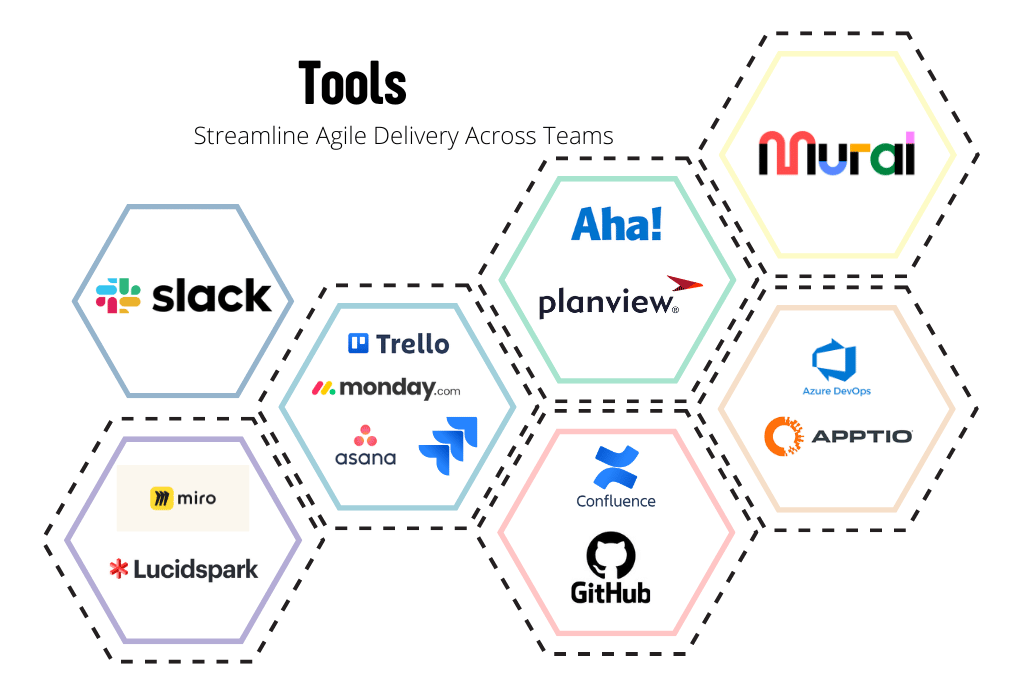
How can you efficiently deliver high-value products and services with distributed teams while ensuring top-notch quality quickly? In today’s fast-changing business landscape, agile frameworks are the go-to for project management and software development. To truly harness Agile’s power, you need the right tools for seamless collaboration, efficient workflow, and impeccable code quality. Let’s explore how leading organizations transform chaos into a well-oiled machine. We’ll uncover common, practical tools and strategies that equip you to lead with confidence and clarity!
People are at the heart of implementing and delivering products and services. It is vital for organizations to create the right environment and equip their teams with the appropriate agile tools to enable an accelerated and high-quality value delivery framework. These tools should foster autonomy, empowerment, and innovation, while cultivating a culture of collaboration, continuous improvement, and growth.
Here are some examples of agile tools that enhance cultural cohesion and promote high-performing teams to develop outstanding products and services.
Issue tracking and project boards for task management.
Built-in CI/CD pipelines.
Pull request reviews and team collaboration features.
Extensive integration options including Slack, Jira, and Azure DevOps.
Why it helps: GitHub streamlines version control and collaboration between developers, aligning with Agile’s focus on continuous delivery and integration.
Purpose: End-to-end project management, from planning to CI/CD.
Key Features:
Boards for backlog management and sprint tracking.
Pipelines for continuous integration and delivery (CI/CD).
Git repositories for version control.
Built-in test management tools.
Why it helps: Azure DevOps is ideal for Agile teams focused on automating deployment processes while maintaining a strong grip on planning and execution.
Purpose: Portfolio management, transparency, and Alignment.
Key Features:
Corporate Strategy, Objectives and Key Results (OKR’s), and Business Cases.
Integration with Jira, Confluence, and ADO.
Aligns the strategic plans to the organization’s execution activities.
Value stream budgets, governance, and operations.
Why it helps: These tools supports strategic planning and funding, operational excellence, and portfolio governance and fulfillment of these strategic plans.
How Tools Integrate
Consider a scenario where ideas are captured in Aha! to manage business cases and strategies. Once these are approved, they become OKRs and are broken down into actionable tasks in Jira. A significant portion of the work involves creating code, which the team stores in GitHub. Meanwhile, communications and decisions are handled via Slack and documented in Confluence. As the team completes tasks and checks in code to GitHub, work item status in Jira is updated and aggregated back into Aha!. Collaboration tools like Miro and Lucidspark aid in brainstorming and planning, completing the system. The results of these collaborative activities can lead to new requirements that feed into Jira and/or Aha!.
Practical Tips for Implementing Agile Tools
For teams and organizations aiming to implement agile tools in their domain, consider these best practices for successful deployment and adaptation.
Involve Your Team: Ensure the people who will be using the tools have a say in the selection process. Their buy-in is crucial for successful adoption.
Training and Purpose: Provide training and explain the purpose of each tool to ensure everyone understands how to use them effectively.
Simplify Integration: Opt for tools that integrate seamlessly with each other. Tools that are tedious to use or don’t work well together will likely be abandoned, wasting valuable resources.
Case Study
Let’s look at a real-world example to see how these tools come together. A healthcare diagnostic company undergoing a digital transformation leveraged Agile methodologies to manage Identity Access Management (IAM) work. The organization leverages the following agile tools within their platform.
Aha! for portfolio and program management. The organization established integration between Aha! and Jira to provide real-time (or close to real-time) information across both systems. This data is usually used by Portfolio, Program, and Project Managers and stakeholders, who need a high-level view of how the value delivery framework is progressing.
Jira for managing and organizing epics, stories, and tasks. The data is created and managed by every team member. It provides detailed information on how each team is fulfilling the work down to the most granular level of work.
GitHub for code version control. This holds the code and notes needed to deliver and maintain the services that the IAM platform is creating, managing, and delivering their services.
Slack for remote communication and coordination. The platform team members use this platform to discuss and distribute information. They have multiple channels created by teams and by events to organize the relevant conversation within the respective channels.
Confluence for documentation and decision-making. Many decisions coming from planning, retrospectives, and other events are captured and made available to key stakeholders through Confluence.
Lucidspark for collaboration and visualization efforts. The organization operates in a hybrid model with team coming in 2 to 3 times a week. Their team members are also spread out across North America, Asia, and Europe. Team events are rarely done in-person. So the organization provided an ability to facilitate interactive live sessions by using collaboration tools.
Integrating the use of these tools enabled them to streamline their processes, enhance team collaboration, and accelerate project delivery.
Conclusion
This list of Agile tools isn’t exhaustive, but it’s a good starting point! The tools you select and how you integrate them should align with your organization’s unique needs. What’s vital is choosing tools that streamline and accelerate your team’s delivery process. The right Agile tools can revolutionize your team’s workflow—boosting efficiency, enhancing collaboration, and ensuring superior deliverables. Empower your team to seamlessly incorporate these powerful tools into your Agile framework.
Are you ready to elevate your Agile delivery? Dive into these tools and watch your team soar!
In this episode, we have Rajan Seriampalayam, an agile servant leader with over 30 years of experience, share how we can engage our teams by providing clarity into our vision and creating space for feedback and recognition.
Questions from the conversation:
What’s going in our industries when it comes to employee engagement?
What shouldn’t we do to drive employee engagement?
How can we cultivate a culture where our teams thrive?
At @InBiteSizelearning , we believe in the power of information. We want to help people, like you, learn everything from best practices to the latest changes in the industry so that you can build a high performing team.
Follow us on Spotify and Amazon Music: @InBiteSize
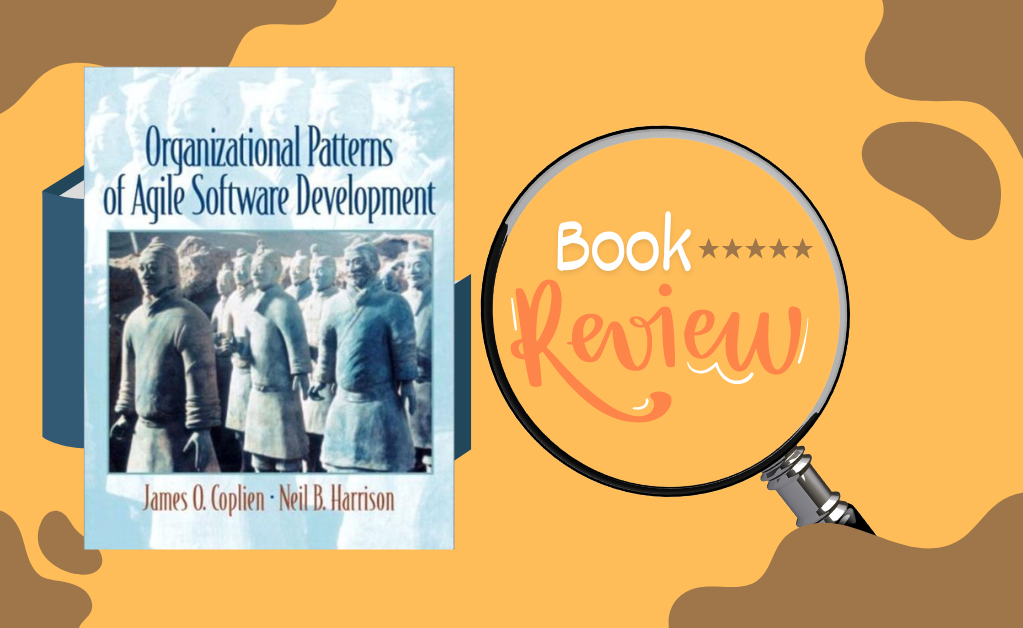
In “Organizational Patterns of Agile Software Development,” authors James O. Coplien and Neil B. Harrison provide an extensive examination of how patterns can enhance the structure and execution of software projects. These patterns are designed to establish organizational wholeness that aligns with and advances the organization’s objectives—improving profitability, increasing productivity, and elevating morale. Delve into this insightful work to uncover the strategies behind agile success.
In this review, I will share some key insights from the book. However, I will not go into detail about each pattern or the pattern languages so that you have a chance to uncover these gems as you read. Instead, my aim here is to give you my takeaways and understanding to help kickstart your journey should you decide to explore the value these organizational patterns have to offer.
What is a Pattern?
Before you can effectively utilize the book’s content, it’s essential to understand what a pattern is and its key elements.
Definition
A pattern is a recurring structural configuration that solves a problem within a specific context, contributing to the overall wholeness of a system—in this case, your organization.
Elements and Characteristics
A pattern is only a pattern if it has the three elements below.
Small: Applies at a local, team level.
Collaborative: Encourages teamwork and emergent structures that enhance organizational wholeness.
Flexible: Can be applied independently or in combination with other patterns.
Pattern Language
The book dives deep into several pattern languages, each designed to tackle different aspects of organizational design and development. Patterns are organized in a certain order, called sequence, within a pattern language.
Pattern languages are structured ways to combine multiple patterns to address complex problems in the organization. They guide you in layering and sequencing patterns for maximum effectiveness.
Types of Pattern Languages in the Book
The book provides four pattern languages grouped based on their intent and purpose.
Design Patterns: Helps you understand the architecture and the relationships of the major parts of the organization.
Project Management Pattern Language: Focuses on scheduling, process, tasks, and work progress.
Piecemeal Growth Pattern Language: Describes growing the product and organizational collaboration.
Construction Patterns: Brings the organization to life by putting the design patterns into practice.
Organization Style Pattern Language: Explores roles and relationships within different organizational styles.
People and Code Pattern Language: Expands Conway’s Law, correlating organizational structure with the product they produce.
How to Use Pattern Languages
Each pattern language offers a sequence (of patterns)—a story—to guide you through its application. While the book is tailored to help organizations achieve their business objectives, these patterns can be adapted for tasks like constructing a house or designing systems. When constructing a house, Design Patterns lay the groundwork and define the architecture, while Construction Patterns bring these designs to life. Within an organization, these patterns are crafted to aid in structuring and executing actions to effectively tackle organizational challenges. Below are examples of the issues they address:
Enhancing communication channels for individuals working in the same location or across different geographical areas.
Managing disruptions while ensuring the team’s continuous progress.
Achieving task completion by drawing on best practices such as prototyping and embracing an iterative approach.
How to Read and Apply Patterns
Understanding how to read and apply patterns from this book is crucial for maximizing their benefits. The authors recommend for the patterns to be initially read in order. The book is broken down into three main parts:
Part I. History and Introduction
Overview of Patterns and Organizational Patterns – Defines what patterns are and the intricacies involved with their relationship with pattern languages and application in the organization.
History and Background of the Patterns – Elaborates on how the authors identified the patterns based on real-life use cases and extensive consultation with practitioners.
How to Use this Book – Explains the mechanics on how to read and apply the patterns
Part II. The Pattern Languages – Expands on each pattern and their relationships within the Organizational Design and Construction Pattern Languages.
Part III. Foundations and History – Explores the effective way to apply the patterns in the organization.
Part IV. Case Studies – Provides the details on actual use cases where the patterns were effectively used.
Each pattern within the Pattern Language has been written in this format. (See example of a pattern in the information box)
Name: A descriptive label.
Stars(*): The number of stars indicate the confidence level and frequency of use.
Context: The situation where the pattern is applicable.
Problem/Forces: Describes the crisis or disruption that threatens project progress.
Solution (starting with ‘Therefore‘): The resolution provided by the pattern.
Rationale and Examples: Explains why the pattern works and provides relevant examples and related patterns that expands or supports it.
Applying Patterns in Your Organization
The authors highlight that the patterns are not magic remedies for all organizational challenges but provide insightful guidelines for Agile practitioners, project managers, and transformation leaders. The patterns are based on principles that drive towards organizational wholeness that leads to consistent product delivery, balance of communication, higher revenues, and engaged team members. These benefits are only possible with a good understanding of the patterns and the context in which they are applicable.
Here are steps to effectively integrate patterns into your organization:
Assess the Organization: Identify weak spots and recurring issues that need addressing.
Focus on organizational wholeness: Patterns intend to support the accomplishment of the organization’s goals.
Apply a strategic approach: Apply patterns where they can be most successful.
Take a piecemeal approach: Think locally but aim to impact the whole system.
Maintain Balance: Communicate clearly and openly.
Reflect and Adapt: Continuously evaluate the effectiveness and relevance of the patterns.
For transformation leaders and agents responsible for applying these patterns to your organization, here are some key points to remember as you embark on your journey.
Patterns are applied iteratively and results may take time.
Multiple paths can be taken based on context and insight.
Leave room for retrospection to ensure relevance and effectiveness.
Minimize disruption by timing pattern application appropriately.
Augment patterns based on organizational practices.
Trust the process, but ensure patterns are relevant.
Promote unity of purpose and involve management.
Conclusion
“Organizational Patterns of Agile Software Development” is an invaluable reference for transformation leaders and teams aiming to understand and promote productivity and consistent product delivery. Rather than following it as a prescriptive textbook, leverage the patterns as best practices combined with your insights into your organization’s readiness and maturity. Create a tailored action plan that helps your organization efficiently apply these patterns, driving toward organizational wholeness.
Blogger’s note: Comparison with Other Literature
When I first picked up this book, I struggled to connect with it and understand its relationship to agile software development. Could it be the writing style? These days, most of the books I explore present concepts followed by real-world use cases and written in a storytelling style, whereas this one adopts a more textbook approach. As I delved deeper, everything started to click, and I saw how the patterns applied. There are numerous books and frameworks that share similar principles, but these ones stand out due to its relevance and familiarity. Isn’t it fascinating how certain approaches resonate more with us? It’s all about finding the right fit for your learning journey.
The Big Red Book on Scrum by Jeff and JJ Sutherland emphasizes small teams for effective communication, akin to the “4.2.2 Size the Organization” pattern.
Scaled Agile Framework (SAFe) focuses on optimizing value streams and team workspaces to establish flow, resonating with the Organizational Style pattern language, specifically the 5.1.12 Shaping the Circulation Realms Pattern*