When it comes to building innovative products, the path to success can often feel cluttered, unstructured, and painfully slow. Principles of Product Development Flow – Second Generation Lean Product Development by Donald G. Reinertsen challenges the conventional approach to product development and offers a compelling framework built on 175 principles aimed at achieving flow in your processes. It’s a must-read for developers, managers, and anyone looking to innovate in product development, while maximizing economic value.
Reinertsen challenges and critiques the “dysfunctional beliefs” entrenched in the prevailing orthodoxy of product development, offering a sharp and thoughtful analysis. These outdated norms hinder innovation, create inefficiencies, and lead to delays. The author goes beyond merely identifying these challenges, offering readers actionable principles that serve as effective solutions to streamline product development and enhance outcomes.
Dispelling Dysfunctional Orthodoxy
Reinertsen identifies 12 common dysfunctions that plague product development organizations. Here’s a brief overview of the ones that stood out most prominently to me:
1. Failure to Correctly Quantify Economics
Many organizations rely on proxy variables to measure performance, often failing to understand the economic consequences of their decisions. For instance, instead of evaluating cost-of-delay metrics, organizations focus on metrics like utilization rates or project ROI, which don’t provide a complete picture of economic trade-offs.
2. Blindness to Queues
Unlike manufacturing, work-in-progress (WIP) inventory in product development isn’t as tangible or tracked. This invisibility results in the underestimation of queue sizes and, consequently, their impact on delays and costs.
3. Worship of Efficiency
While efficiency may sound desirable, focusing solely on maximum utilization leads to overloading systems and increasing queues, ultimately delaying projects and raising costs.
4. Hostility to Variability
Large batch sizes are often seen as efficient; however, they can lead to bottlenecks and longer cycle times. Smaller batches, though less flashy, achieve streamlined flow by reducing queues.
5. Institutionalization of Large Batch Sizes
While efficiency may sound desirable, focusing solely on maximum utilization leads to overloading systems and increasing queues, ultimately delaying projects and raising costs.
6. Managing Timelines Instead of Queues
Focusing on strict timelines rather than managing tasks based on value (or cost-of-delay) results in inefficient resource utilization and misaligned priorities.
7. Centralized Control
Centralized decision-making might feel like the safer choice but often stifles flexibility. Decentralizing decisions speeds up product development and empowers teams to innovate.
By addressing these dysfunctions, Reinertsen offers a roadmap to not only improve process efficiency, but also foster creativity and innovation within product teams.
The Core Themes of Flow-Based Product Development
The book introduces eight core themes designed to challenge and replace dysfunctional norms, offering principles that pave the way for effective, flow-based product development. Together, these themes provide a clear blueprint for transforming how organizations approach product development.
1. Economics
One of the key messages in the book is the importance of applying an economic lens to every decision. Understanding the cost-of-delay allows teams to objectively quantify trade-offs and make informed decisions on 5 economic objectives: cycle time, product cost, product value, development expense, and risk.
2. Queues
Reinertsen underscores the detrimental impact of large queues on cycle times and feedback delays. Tools, like Little’s Law and Cumulative Flow Diagrams, can help track and optimize queue size, ensuring smoother processes.
3. Variability
Rather than eliminating variability, the key is managing its economic impact. Techniques like variability pooling—combining diverse tasks to offset fluctuations—can help teams reduce the adverse effects of unpredictability without stifling innovation.
4. Batch Size
Reducing batch sizes improves workflow and shortens cycle times. Smaller batches not only decrease transaction costs, but also reduce overall expenses over time, paving the way for quicker iterations and more efficient feedback loops.
5. WIP Constraints
Implementing WIP limits prevents bottlenecks and helps control flow. A simple, but effective principle Reinertsen advocates is “progressive throttling,” where teams prioritize work during times of high congestion by allocating resources strategically.
6. Cadence and Synchronization
By syncing work processes at regular cadences, teams can ensure predictability and reduce variability in feedback loops and release cycles.
7. Fast Feedback
Early feedback prevents teams from going too far down the wrong path. This principle doesn’t just apply to user feedback—internal feedback loops behave similarly and drive alignment.
8. Decentralized Control
Empowering teams to make independent decisions, rather than depending solely on centralized authority, enhances development speed and boosts responsiveness. While decentralization fosters agility and team autonomy, it isn’t always the best approach. Certain situations still require centralized control to ensure effective decision-making when necessary.
The Core Themes of Flow-Based Product Development
Whether you’re new to product development or a seasoned professional, the book offers value for all readers.
Beginners should approach it as an introductory, yet comprehensive guide to understand foundational principles and their applications in product development.
Experienced professionals can use the book to identify specific areas of improvement or reference the principles most relevant to their current challenges.
Reinertsen’s conversational tone and practical examples make even complex concepts approachable, though readers might need some patience with the technical aspects of economic analysis and mathematical queue theory. From my experience and prior learning, the problems and solutions felt familiar. However, I valued the chance to delve deeper into concepts like queues, batch sizes, and other foundational ideas. Exploring the equations and frameworks behind these industry best practices provided a deeper understanding and fresh perspective.
1
Failure to Correctly Quantify Economics
One common mistake is relying on proxy variables that don’t truly reflect the economic outcomes of an organization’s decisions. To drive meaningful change, it’s crucial to measure what matters.
2
Blindness to Queues
Have you considered the hidden cost of queues in product development? Many don’t, and here’s why:
Incomplete designs aren’t tracked as inventory—they’re financially invisible, only showing up as assets once complete.
Design-in-process (DIP) inventory is also physically invisible. Unlike tangible objects, it exists in bits and pieces, making it easy to overlook.
3
Worship of Efficiency
Focusing solely on maximizing efficiency, like keeping everyone busy at full capacity, can backfire. High utilization may boost efficiency but often increases costs and delays by creating longer queues. Sometimes, less is more.
4
Hostility to Variability
Does variability seem like a bad thing? It’s common to view it that way, but variability is at the heart of innovation. Instead of eliminating it entirely, consider how it can foster creativity and add value.
5
Worship of Conformance
Sticking rigidly to original plans or designs might feel safe, but it’s not always the smartest choice. Adapting to new opportunities, like emerging technologies, can unlock greater economic value.
6
Institutionalization of Large Batch Sizes
Large batch sizes may look efficient on the surface, but they often create bottlenecks, increase cycle times, and amplify variability. Smaller, manageable batches can lead to smoother workflows and faster results.
7
Underutilization of Cadence
Without regular cadence or synchronized processes, feedback often comes too late—once products are nearly finished. Establishing cadence ensures timely reviews and helps course-correct before it’s too late.
8
Managing Timelines Instead of Queues
Why prioritize strict schedules over delivering value? Focusing on timelines often leads to excessive planning, while managing variables like queues can more effectively control cycle time and drive results.
9
Absence of Work-in-Progress (WIP) Constraints
Uncontrolled WIP leads to longer queues and extended cycle times. Lean manufacturing has long used WIP constraints to keep workflows efficient—product development teams can benefit from the same approach.
10
Inflexibility
High-utilization environments of highly specialized teams or of specialized resources can limit flexibility. When variability strikes or rebalancing is needed, inflexible teams struggle. Cross-training and broader skill sets can empower teams to adapt and thrive.
11
Noneconomic Flow Control
Are your project controls and prioritization aligned with economic value? If not, you could be relying on a narrow perspective—prioritizing metrics like ROI while overlooking the broader impact of delays on overall profitability. By shifting your focus to consider the true costs of delays alongside profitability, you can make more informed and effective decisions.
12
Centralized Control
Does everything in your process flow through a central authority? While it might seem efficient, over-centralization slows feedback and decision-making. A decentralized approach encourages faster responses and empowerment across teams.
Twelve critical problems with the current product development orthodoxy
My Takeaways
Reinertsen’s book stands out as a critical resource for product developers and managers looking to drive efficiency without compromising on innovation. It’s a wake-up call for organizations stuck in outdated processes and provides a clear path forward based on lean principles adapted for high-variability environments, like product development.
The book highlights the hidden costs of delays and invisibilities, such as unseen queues and work-in-progress, while underscoring the importance of economically sound decision-making. It serves as an invaluable resource for leaders managing cross-functional teams in fast-paced environments, guiding them in creating innovative products with greater efficiency and impact.
Who Should Read This Book
This book is especially valuable for:
Product Developers: Looking to innovate and adopt a flow-based approach.
Product Managers and Owners: Focusing on aligning teams with lean principles and economic priorities.
Management Consultants and Coaches: Working with organizations on optimizing product development cycles.
Team Leaders: Hoping to implement process improvements while fostering creativity and adaptability.
Final Recommendation
If your organization struggles with inefficiencies, bottlenecks, or a lack of innovation in product development, Principles of Product Development Flow is an indispensable read. It’s more than just a guide—it’s a call to action to rethink outdated practices and reimagine what effective product development can look like.
Whether you’re building a brand-new product line or trying to refine your processes, this book will empower you to establish flow, minimize delays, and maximize economic value. Read it, implement it, and watch your teams transform.
Do organizational frameworks really drive results, or are businesses relying too much on oversimplified solutions for complex challenges? Stephen E. Morris’ Leaders, Believers, and Expert Deceivers tackles this question head-on, delivering a refreshing, no-nonsense approach to leadership and decision-making in organizational settings.
Morris invites readers to explore what it truly means to understand their organization’s unique context. Blending wit, humor, and a touch of cynicism, this book acts as both a guide and a mirror, challenging leaders to face uncomfortable truths about their teams and systems. With its sharp insights, it inspires meaningful change and fosters effective evolution of the organization to keep it relevant to its customers, their environment, and the people within it.
Whether you’re a seasoned executive or an eager team member, Leaders, Believers, and Expert Deceivers offers valuable insights into the complexities of leadership, product delivery, and organizational dynamics.
Key Themes and Messages
1. The Importance of Sense-Making
Morris emphasizes that every organization is a complex system requiring a clear understanding of its context before determining the best course of action. Sense-making—a concept originally coined by Karl Weick—is the foundation of this process. It’s likened to a music studio’s mixing desk, where each instrument must be adjusted to achieve the perfect harmony.
Sense-making isn’t just about understanding the external environment. It means interpreting an organization’s vision, purpose, and strategy while accounting for unpredictable elements like culture, habits, and human behavior. Using sense-making frameworks like Cynefin, leaders can foster meaningful discussions and determine their next course of action that align with their goals.
2. No One-Size-Fits-All Framework
Morris challenges the idea of universal leadership solutions. Instead, he highlights that a blend of approaches is often necessary. Organizations are a dynamic mix of predictable and unpredictable situations, requiring leaders to adapt their strategies for different contexts.
Why, then, do so many organizations adopt standardized frameworks? Morris identifies several reasons, from blindly following what the boss says to seeking quick fixes for complex problems. He offers a brutally honest critique of these tendencies, encouraging leaders to move beyond the comfort of one perfect framework. It involves leveraging existing frameworks complemented with the knowledge within the organization and its partners to establish tailored solutions.
3. The Role of Direction and Strategy
Knowing an organization’s purpose and aligning it with strategy can make all the difference. Morris outlines how clarity around vision, purpose, and objectives can empower teams, enhance decision-making, and foster a sense of belonging. He advocates for breaking down grand visions into manageable components and employing a variety of styles to make them more relatable and easy to understand, using tools like Objectives and Key Results (OKRs) and team-level discussions to keep teams aligned.
An example that Morris provides is IKEA’s effective use of their showrooms to visualize the application of their products in various spaces. On a similar note, organizations should not expect that a presentation of the corporate goals and strategy through mass email or a town hall meeting will result in alignment or a common understanding of the message. They have to make it relatable and relevant.
4. Complexity in Teams and Decision-Making
Morris explores how teams differ in function and structure, emphasizing the importance of applying the right type of team for a given task. He dives deep into the development of high-performing teams, stressing the role of skills, knowledge-sharing, and real-world experience over theoretical know-how.
A common misconception about organizational capabilities- skills and knowledge that employees have – falls under a bell curve. In reality, it takes on the Paretian principle (or the 80/20 rule), where the productivity of the organization is due mostly to the skills and knowledge of 20% of the employees, thus, the chart looks more like a hockey stick instead of a bell curve: the expertise lies on the far left of the chart and takes a deep dive into the right side of the chart. Morris promotes the importance of leveraging the 20% to support and enhance the skills and knowledge of the organization.
Additionally, he highlights the challenges of culture and habits, noting that successful change requires addressing behaviours rooted in comfort zones or reservations (or fear).
5. Understanding Change and Transformation
The book concludes with actionable advice on navigating change within organizations. Change, Morris argues, is inherently challenging because it disrupts established norms and triggers both physical and social fears. To succeed, leaders must carefully consider three specific thoughts:
Assume that both your change purpose and strategy will evolve – Embrace experimentation with different approaches, understanding that some will succeed while others may fail. It’s unrealistic to expect purpose and strategy to remain static, and trying to do so can lead to frustration for everyone involved.
Prioritize narrative difference – Share and leverage successes from various approaches, training sessions, tools, or techniques that foster collaboration and drive improvement across the organization. These stories can inspire growth and unity.
Iterate habits and heuristics – While these heuristics – mental shortcuts – can simplify and accelerate decision-making, it’s important to recognize when they become outdated. Actively work to adapt and transform these patterns into meaningful behavioral change.
Organizational Dynamics and Decision-Making
What sets this book apart is its nuanced exploration of organizational behavior. Morris dives deep into why organizations often stick to ineffective practices, offering thought-provoking explanations such as:
Blindly following industry trends or popular certifications.
Ignoring deeper problems because of cultural or habitual blind spots.
Avoiding accountability by relying on oversimplified tools or frameworks.
He doesn’t just stop at identifying these issues—he provides solutions and examples grounded in context, critical thinking, and communication. Exercises like mapping out future scenarios or running sense-making discussions provide tangible tools for overcoming real-world challenges. Morris encourages leaders to step away from the illusion of “one perfect answer” and instead champion open dialogue, diverse perspectives, and adaptive thinking.
Final Thoughts
Stephen E. Morris’ Leaders, Believers, and Expert Deceivers is both an eye-opener and a practical guide for anyone navigating the complexities of leadership and organizational decision-making. It challenges conventional wisdom, advocates for thoughtful exploration of context, and equips readers with tools to make informed, impactful decisions.
If you’re ready to think differently about leadership, challenge the status quo, and lead your teams with intention and clarity, this book is a must-read.
Call to Action
Take the first step toward transforming your organization—grab a copy of Leaders, Believers, and Expert Deceivers. Then, get ready to inspire meaningful change where it matters most.
About the author
As an Agile Evangelist, Rochelle Tan has over 20+ years of experience in agile transformation with small to large organizations from various industries in North America and Asia: Oil and Gas, IT, Healthcare, Finance, Insurance, and Government.
In this season, we’re bringing you bite-sized, insightful conversations with industry leaders, teaching concepts and providing you with actionable steps in around 10 minutes or less.
In today’s episode, join Ahmed Gad, an experienced product manager and startup founder, as he shares his expertise on mastering career pivots and building a roadmap for success.
✨ What you’ll gain:
1️⃣ Proven steps to transition from software engineer to startup founder
2️⃣ A practical framework to plan and grow your career strategically 🔔
Subscribe now and hit the notification bell to stay ahead with bite-sized career and leadership insights!
Follow us on Spotify and Amazon Music:@InBiteSize and be sure to subscribe to our YouTube Channel! Thanks for watching!
In the early 2000s, the world discovered a groundbreaking approach to software development: Agile. Grounded in essential values and principles, this method aimed to bring customers closer to the teams doing the work, while empowering those teams, speeding up delivery, and encouraging early feedback—all through an iterative development and continuous improvement process. But as anyone who’s implemented agile can tell you, there’s more to it than what you find in textbooks, blogs, or YouTube tutorials. It calls for the right tools to ensure everything runs smoothly.
In this article, we’ll dive into how specific tools can enhance value delivery by exploring how different tools support the five elements of the agile delivery framework. Whether you’re a Product Manager, Scrum Master, or Software Developer, this guide is crafted especially for you. Get ready to unlock the power of Agile with the right toolkit!
Why Tools
Matter
Remember the first time you tried to assemble IKEA furniture without an Allen wrench? That’s like attempting agile without the right tools. The goal here is to make life easier, not harder. From roadmaps to retrospectives, specialized tools can turn tedious tasks into streamlined workflows, freeing up your team to focus on what they do best—creating awesome products! Here are several industry-tested tools that effectively support the five elements of the agile delivery framework.
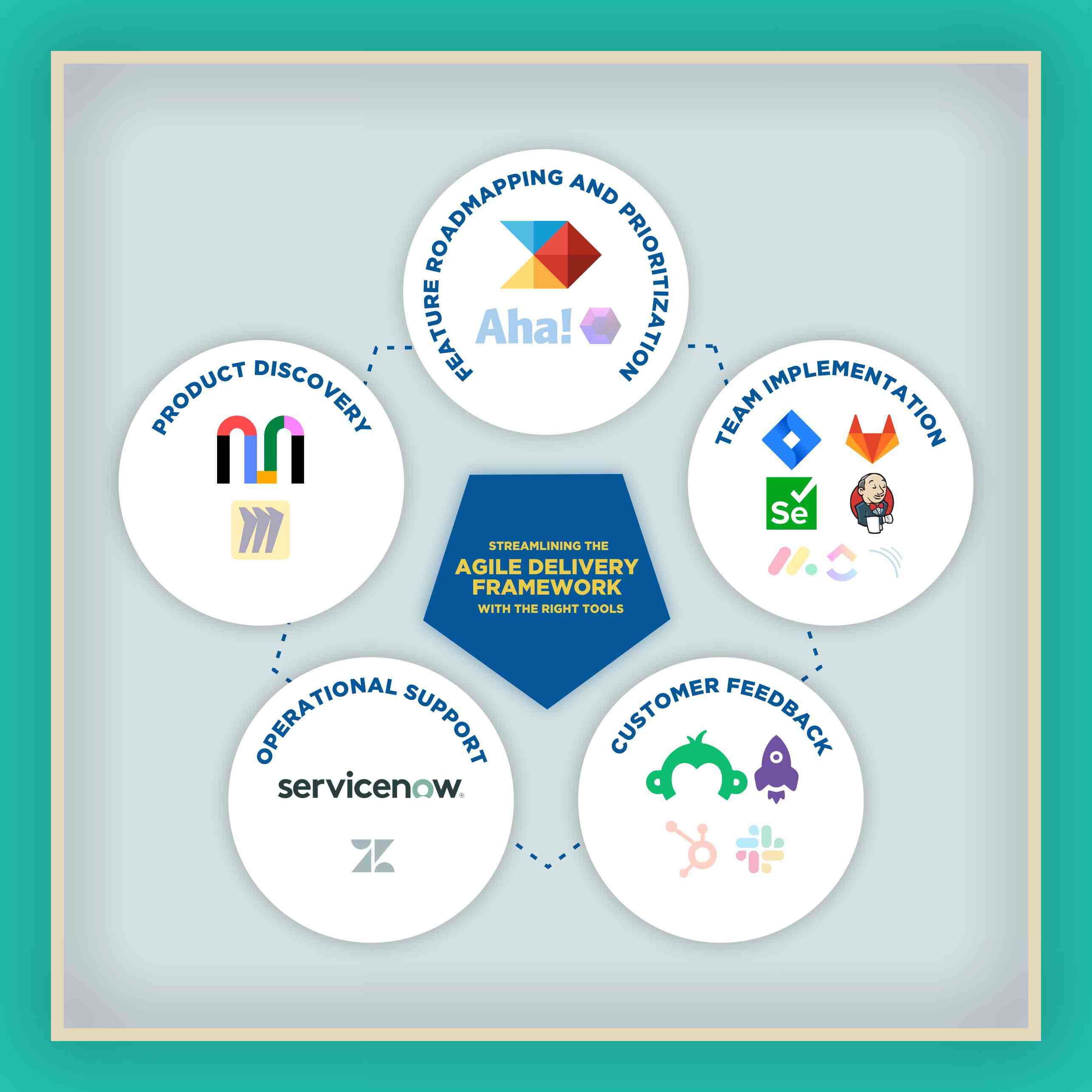
Before you can deliver, you need to discover what’s worth delivering. Product discovery is the secret sauce that turns good ideas into great products. Fortunately, tools are available to turn your brainstorming sessions into a process for identifying business capabilities and outstanding products.
Mural & Miro: These collaboration tools are like digital whiteboards. They allow teams to brainstorm, map out user journeys, and sketch wireframes. Whether you’re halfway around the world or across the hall, these platforms facilitate real-time collaboration.
Not all features hold the same importance. Some are crucial for deploying Minimum Viable Products (MVPs), while others are merely “nice to have’s” or can be postponed for future implementation. The trick is knowing which is which. Product management tools should facilitate the creation and execution of product plans as the product evolves through its lifecycle.
ProductBoard & Chisel: These tools help align your product vision with business capabilities. Incorporating AI for feature suggestion and prioritization, they can alleviate the administrative burdens on Product Managers.
Aha!: Perfect for visualizing features and aligning them with business capabilities, Aha! gives you a single place to manage your product plans.
Here’s where the rubber meets the road. Team implementation is the heart of Agile delivery, where ideas turn into reality. Team implementation involves the planning, execution, and delivery of high-value products to the customers when they want it. Tools that support the various aspects of team implementation must promote visibility, completion, automation, quality, and speed. Here are some products that many organizations have leveraged to support their value acceleration initiatives:
JIRA, Monday.com, & ClickUp: Trusted by Agile teams worldwide, these tools manage everything from backlogs to sprint planning. They allow you to set up workflows, track progress in real time, and even automate repetitive tasks.
SonarQube: Focused on code quality, this tool integrates seamlessly with your continuous integration pipelines to ensure that what’s being built meets your standards.
Jenkins, Selenium, and GitLab CI/CD: Automation is a critical component in Agile delivery by streamlining repetitive tasks and enabling teams to focus on more strategic activities. Automation tools like Jenkins, Selenium, and GitLab CI/CD enhance productivity by automating builds, tests, and deployments. These tools ensure that software is continuously integrated and deployed, reducing the risk of errors and accelerating the release of features.
Once a feature is live, the customer becomes your most valuable tester. Listening to them is key to continuous improvement. By providing an easy mechanism to capture user feedback and behavior with your products, you can develop features that promote stickiness and satisfaction.
Slack,HubSpot, SurveyMonkey, LogRocket: You can gather feedback directly from customer interactions or surveys, turning it into actionable insights.
Finally, don’t underestimate the importance of operational support. It’s the unsung hero of Agile delivery, ensuring everything runs smoothly. There is no perfect solution and products need to evolve with its customers’ changing needs. Thus, your organization must provide an avenue to collect requests or issues so that the implementation team can address them efficiently and effectively.
ServiceNow & Zendesk: These platforms streamline issue tracking and service requests, providing a structured system for managing incoming queries and problems.
An
Integrated
Approach
The tools are crafted to simplify information flow and optimize workflows, boosting collaboration and efficiency. Achieving this requires integrating these tools to ensure seamless connectivity between your processes, people, and the tools your team employs. Here’s an example of how an integrated system can lead to faster and higher-quality delivery.
Product Discovery
Product Roadmaping and prioritization
Team Implementation
Customer Feedback
Operational support
Product Discovery
LogRocket to analyze and gather user behavior and system response. Any issues are easily created in Jira without any manual encoding.
Operational support
ServiceNow for work intake (e.g., requests, enhancements, issues, inquiries)
Conclusion
Although the tools discussed in this blog are not an exhaustive representation of what’s available on the market or how tools are configured, they provide a starting point that you can review and revise to support your organization’s agile delivery framework. However, remember that these are merely tools; their true value lies in how they are utilized. Therefore, choose wisely, test carefully, and continually reassess to ensure they meet your needs.
The future of agile delivery is promising, but it shines brightest for those prepared to adapt and optimize. Isn’t it time your team joined the ranks of the streamlined and successful?
In this season, we’re bringing you bite-sized, insightful conversations with industry leaders, teaching concepts and providing you with actionable steps in around 10 minutes or less. In today’s episode, we are joined by @StephenEMorris , speaker, author and award-winning leader to speak about the importance of context in order to bring forth transformational change to your organization.
✨ In this video, you’ll learn:
1. Why understanding your organization’s context matters
2. What you can do as leader to ensure your teams understand the problem to be solved and how to work together towards an impactful solution
🔔 Don’t forget to subscribe and hit the notification bell so you never miss an episode!