
by admin | Dec 24, 2023 | InBiteSize
It’s 10:34 pm and I’m sitting at my younger sister’s house and trying to figure out what to say. It’s been an intriguing year. A lot has happened, and a lot didn’t happen either. I ask myself, what am I supposed to be feeling? At peace? Hopeful? Thankful? If anything, I’m a bit anxious…
If you have read through The Beginning of it All, then you’ll know Rochelle Tan and I embarked on this adventure to start InBiteSize earlier this year. For the past seven months, we’ve been hard at work to curate a selection of tools and reviews to help you, help your teams become great. On top of that, we’ve been researching ways to make our work more accessible, effective, and relevant. For example, we introduced an article regarding AI in November.
In my own world, I picked up two new sports, biking and running, and competed in my first professional race. (In fact, I was crazy enough to sign up and complete two of them within a two month period) I was amazed with my own discipline to the sport and my commitment to not finishing last. In addition, I gained a new appreciation of a hobby (running) that both my mother and younger sister love. Hopefully, it is something that I can share with them even though we’re 1,900 miles apart.

On top of that, I’ve entered a new life stage with my longtime partner. We tied the knot this past summer and now reside in a suburb of the San Francisco Bay Area. It’s been fun going on spontaneous weeknight dates to Costco and knowing that I have someone to come home to. Plus, I have come to realize how lonely I truly was during the pandemic and how much I craved social connection. Now, I make sure that I cherish the time I have with others.
So, what’s going on? Maybe I’m anxious because I feel that I have people counting on me every moment of my life. One, I now have deadlines outside of work. Two, I no longer live alone. Three, we have an adorable cat that relies on us. For each of these relationships, I strive to be a better partner. To me, that means giving my 100% in all the endeavors I commit to, while also making sure I give 100% to myself. And I think, am I doing enough…

What I have learned from watching Brené Brown’s docuseries Atlas of the Heart, anxiety, and excitement are two sides of the same coin. That same tension and shortness of breath we experience when we’re anxious is very similar, if not the same physiology that we feel, when we’re excited. As Brown puts it, it may be time to befriend anxiety.
Let me start over. It’s 11:44 pm, and I’m lying in bed at my younger sister’s home and reflecting on all that has come to pass. There’s been many highs from starting this blog with Rochelle to achieving a personal record (PR) in the 5K. Likewise, there’s been many challenges, like navigating the home-buying process in the San Francisco Bay Area and all the people-pleasing and society-shaming that comes with wedding planning. It’s been an intriguing year.
So how am I feeling? Frankly, I didn’t undergo a huge emotional transformation in the last hour. Yes, I’m still a bit nervous. Yes, there’s still a lot of thoughts swirling in my head. And yes, I still feel a little sick in the stomach at the thought of them. And maybe I’m a little bit excited, too, because there’s a lot to savor and be proud of. Plus, I know there are many great things to come in the new year from InBiteSize’s new podcast series to my partner and I’s first trip to Japan.
So as the year winds down and a new one approaches, I’ll take a cup of kindness yet for Auld Lang Syne.
Looking for a bit of inspiration for the new year? Check out How To Find A Hobby or one of our book reviews, including Atomic Habits, and The Tipping Point.

by admin | Dec 14, 2023 | InBiteSize
Can you believe it? It’s already December. With that comes a frenzy of holiday shopping, a slew of reunions with coworkers and old friends, and potentially a string of looming thoughts about the year to come. We get it. With all the excitement and good cheer, one could still get overwhelmed and start ruminating over all the things that could have been. Never fear, we’re here to talk about James Clear’s, Atomic Habits: An Easy & Proven Way to Build Good Habits & Break Bad Ones.
In this blog post, we’ll be giving you a snapshot of Clear’s four laws to help you get your head in the game, now. When the new year comes around, you’ll already be moving one step closer to the person you aspire to be.
What makes Clear’s book so fascinating is that he provides you with an unconventional way of building good habits (and reducing bad habits). It’s obvious to us that change takes time. Or else, why would there be tons of motivational books and quotes flooding our newsfeeds. To help us visualize the impact of our small changes, he tells us to imagine an ice cube sitting at 25 *F. With each degree change, not much happens. However, once the temperature reaches to 32*F, it melts. Even though we cannot see it, every step we take moves us towards or away from our goals.
Clear also teaches us that we should focus on the processes we leverage to achieve our goals instead of our goals themselves. For the agilist out there, does this concept ring a bell? (Hint: do you recall the Scaled Agile Framework Principle #2: Apply systems thinking?) One of the many problems of focusing on a goal is that once we achieve it, we have a tendency to revert back to our old, bad habits.
In my case, after completing my first Duathlon back in August, my Strava has completely flatlined. Instead of focusing on my goal of finishing my race, I should have been putting in effort to build my system, which could include how often I should workout, how I would handle plateaus, or how often I should take time for rest and recovery.
Lastly, Clear brings forth the idea of having identity-based habits over outcome-based habits. He provides us with an example of a smoker who is trying to quit. When offered a cigarette, there’s a profound difference in response #1) No thanks, I’m trying to quit vs. response #) No thanks, I’m not a smoker.
The reason why some folks fail to achieve their goals is that although they have changed their behaviors, they haven’t changed their identity– something that we hold dear. This dissonance may cause us to relapse to our bad behaviors. As we strive to build good habits and eliminate bad habits, we need to pivot our identities, too.
To do this, he has a two-step process.
- Decide the type of person you want to be.
- Prove it to yourself with small wins.
In my case, I want to be an athlete. By reshaping our thinking and formulating atomic habits–regular practices or routines that are not only small and easy to do, but also the source of incredible power– we will be on our way to reaching our goals and beyond.
In the following sections, I’ll first focus on how you can apply Clear’s four laws to build good habits.
The first step of any habit-building is to make it obvious. One method Clear shares is called Pointing-and-Calling, which is leveraged by the Japanese railway system. By calling out all the things you do in a day, you can start to identify things you can adjust.
From there, you can make your habits more obvious by using the cues of time and location. To emphasize cues related to time, you can use Habit Stacking, where you pair a new habit with an existing habit. For me, whenever I am out of water, I do five squats [new habit] before I go downstairs to refill my cup [old habit].
For cues related to location, you can look at ways you can enhance your environment. Clear mentioned a case where a physician at Massachusetts General Hospital in Boston rearranged a cafeteria by adding more water bottle stations. As a result, the sale of water increased by 25.8%, while the sale of soda reduced by 11.4%. An individual person didn’t have to make any adjustments on how they ate. Water was just more available, so it became easier to choose it over soda.

For this second law, Clear explains the power of dopamine, our neurotransmitter involved in our motivation. We actually get more excited in the anticipation of our reward than the reward itself. As a result, we could use temptation bundling, where we stack a habit we want with a habit we need. For me, after I pull out a bag of chips, I will write one paragraph. After I write one paragraph, I will eat the chips! By using this tactic, I begin associating writing with the same feeling of excitement I get when I get my hands on a bag of chips.
Secondly, you can also surround yourself with like-minded people. Clear talks about a Hungarian man named Laszlo who aspired to raise chess masterminds. As a result, Laszlo found a partner that shares his values and created a family that rewarded a love of chess. When asking his daughters if they disliked the environment that they grew up in, they said that they couldn’t get enough of the sport.
In conclusion, social norms play a huge role in our behaviors whether we like it or not. Therefore, we should use them to our advantage. Haven’t you just felt more empowered to do that extra rep at the gym versus when you’re at home? In my case, does anyone know of any Swiftie Workout Meetups in the Bay Area? Please send them my way.
Since habit formation is a journey, Clear introduces his third law, making it easy. The problem with building good habits is that it’s not about how long we’ve been practicing the new behavior, but instead the number of times we actually practiced the habit in a given time. Therefore, our new habits should be executed as easily as possible.
One thing to consider is how you can reduce the friction surrounding habits you want to form. Being an athlete, I lay out my workout clothes in the morning and keep my running shoes by the door instead of in the closet. Another practice is priming your environment. Have you ever been in a situation where you had every intention to eat a salad for lunch, but caved in and ordered Doordash? To combat this, you can prepare meals for the week and have your fixings ready for your salad so that the easy choice is something that is already ready to go.

Another practice you can do is perform one time actions that lock in good habits. In his book, Clear speaks about John Henry Patterson, a manager of a supply store that was facing a problem of employee theft. To curb it, he leveraged Ritty’s Incorruptible Cashier that locked the register after every transaction. By investing technology that automated ethical behavior, Patterson went from losing money to making a profit! For example, if you’re trying to save money, you could unsubscribe from promotions or create automation rules in your inbox that automatically move offers to a hidden folder.
If those don’t work, Clear has a two-minute rule, when you start a new habit, it should take less than two minutes to do. As I add strength training into my routine, what I can start with is just doing one rep each day. What this rule forces me to do is to show up. Each time I show up, I up my practice count, which helps my habits settle in a little bit more.

For this final law, it’s all about ensuring that we keep on making the changes we need to reach our goals. With the rise of mobile gaming and social media, we have become a society of instant gratification. Therefore, the fourth law is all about using that to our advantage.
To open this section, Clear shares a story on how a public health worker named Stephen Luby drastically reduced health incidents of children in Karachi, Pakistan by introducing a soap that people loved to use. Safeguard was a soap that was super sudsy and smelled great. Whenever they used it, they were immediately rewarded by its scent and the feeling of cleanliness from the suds.
To leverage instant gratification, you can incorporate small wins through strategies like habit tracking. For me, I get a little thrill every time I check another day off on my calendar whenever I workout or cross off something from my to do list. Another tactic is rewarding yourself when you did nothing. In my case, every time I don’t spend $5 on a new bag of Kirkland Signature Kettle Chips, I can put $5 towards my vacation budget.
And finally, we are all human, and we will miss a day. The all-or-nothing mentality will derail our journey towards our goal. Clear’s only suggestion is that if this happens, we don’t miss it twice. In the end, do what makes sense to you as long as you’re putting in “practice” every moment you get.
When it comes to bad habits, you take the antonym of Clear’s laws. Instead of making it obvious, you make it invisible. As an athlete, it’s important that I maintain a healthy diet. As a result, I have either hidden or stopped buying potato chips, my guilty pleasure. I have also modified my environment by deeming my office as a no eating zone to reduce snacking.
Instead of making it easy, you make it difficult. As a result, I sometimes put my chip bags on the highest shelf of my pantry. In order to get it, I have to use a step ladder that is in the garage. The more steps and barriers you implement, the better chances you have of reducing that habit. You get the picture? All you have to do is take each law, flip it, and stick to it to eliminate a bad habit.
As Clear mentioned, there’s no need to make great leaps to your routines now. It’s all about starting small. As I wrote this post, I told myself “Cassandra, you just need to write 250 words today and then, another 250 tomorrow. By day four, you will have written 1000 words and you can call it a day!”
Therefore, do what you can today. Tweak something about your environment. Spend one minute reflecting on who you want to be. Whatever it is, choose something that you can digest. In fact, we might even recommend that you find something that is small enough that you would call it bite size.
Identify as a lifelong learner & coach? Here are a few posts you can check out: Tribal Unity Book Review, Trick or Treat: Facilitator’s Edition, and Collaborate with Mural,
by admin | Oct 29, 2023 | InBiteSize
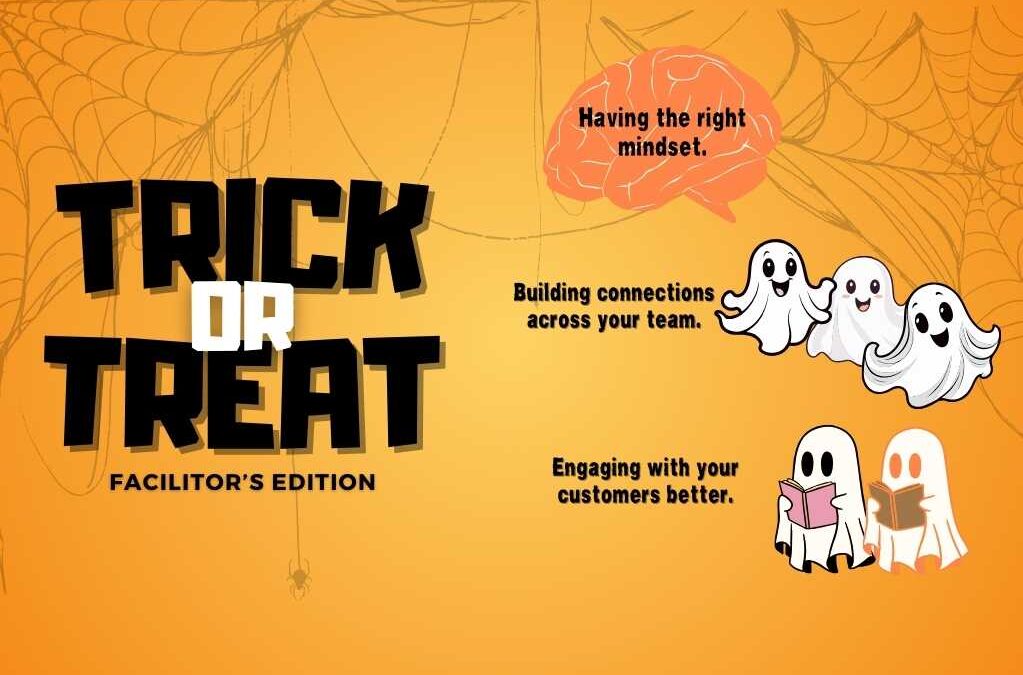
In honor of Halloween, we are sharing our treats. Because the holidays are around the corner, we are aiming to be extra sweet! Over the past several months, we have been sharing with you some of the tools, such as Miro and Mural, that we leverage in order to engage our teams in a hybrid world. In this blog post, we will be diving deeper and covering a collection of tricks and treats that you can use to build your facilitator’s toolkit.
The topics we will cover include:
- Having the right mindset
- Building connections across your team
- Engaging with your customers better
First, we want you to have the right mindset. Whether you are a Project Manager, Agile Coach, or a budding servant leader, you have to remember that your “personal” agenda should NOT be the driver of any meeting. Lyssa Adkins, the author of Coaching Agile Teams, describes behaviors you should move away from, such as knowing the answer & fixing problems, and actions you should move towards, such as focusing on business value delivery & guiding your teams.
Two other mantras from the Agile Coaching Institute (ACI) that you can follow include:
- I create the container. They create the content.
- My actions enhance their self-organization.
The key takeaway is that you should focus on the outcomes and objectives set up by the owner(s) of the meeting. For example, if you are in a Daily Scrum, the owners of the meeting are the team. If folks are getting too technical and focusing on solutions instead of their intentions for the day, you have the right to interrupt and remind them of their goals for the session.
Now that you are aware of the mindset that you should embrace, here are some tools to help strengthen your team’s connection with one another. They can be used when your team is coming together for the first time or when they have lost their way and need to revisit their purpose.
The first thing you should start with is putting together a poster that describes your team’s goals, needs, mission, and purpose. Some of the templates we have found useful include The Team Canvas, Voltage Control’s Focus Finder, and Atlassian’s Team Poster. (Note for the Team Poster you and/or your organization will need to have an Atlassian license to access their playbook). Choose the one that makes sense given the state of your teams. In fact, you can use a combination of these templates and then, synthesize the results. Remember to take the time to review your team’s canvas on a set cadence.
Another way to build a connection is to use icebreakers. Of course, there are the traditional ones, like two truths and a lie, and never have I ever. The problem with these options is that they are overused and do not incite engagement. After taking the ACI’s Agile Team Facilitation course, we were introduced to the concept of Tribes and Constellation. These exercises get people moving and teach your team about the system they operate in. They can be used with a variety of team sizes and can be adapted in a hybrid environment. For example, for Tribes, you can use the Raise Hand function of Teams for people to opt-in and out-out.
Once your teams have started to create a connection, it is time to connect with your customers. The typical methods involve large-scale forums or suggestion boxes that become overflowed with requests. The problem with these is that they may dehumanize your customers. In fact, we have seen where forums have become customer complaining sessions. There were lots of high emotions and very little action. Therefore, it may be good to take a setback and understand what value you bring your customers.
To do this, we recommend leveraging Strategyzer’s Value Proposition Canvas. As a facilitator, there are instructions you can follow. There is also a short video that you can use to introduce the concept to your teams. Plus, it can be done virtually, in person, and in a hybrid setting. After building the canvas, you’ll have a clear view of how your team can add value, and it can be iterated over the evolution of your products.
Another set of options includes Luke Hohmann’s Innovation Games. Have you ever been in a situation where your customers really want something, but can’t seem to give you a list of requirements? Never fear, Hohmann introduces to us 12 games that we can use to better understand the product that we are building. He does this by challenging our audience to think outside of the box. Some of our favorites include Buy A Feature and Give Them a Hot Tub. Just like Strategyzer, he provides an in-depth analysis of how to leverage the games. Therefore, you will know how to set up the game, facilitate the session, and then, summarize the findings.
In conclusion, the above are just a sample of tricks and treats that you can share with your teams. Some of our favorite websites to get inspiration from include tastycupcake.org and gamestorming.com. If you prefer a more guided experience, check out Training from the Back of the Room by Sharon L. Bowman. It has a collection of techniques you can use so that your teams remember and use what they have learned.
In the end, having the right mindset is the foundation of every toolkit. Another way to put it is that you do not need to use a hammer when a mallet is good enough. As a facilitator, you need to be aware of the tools that you have and use them in a way that makes sense to your teams. Do not use something just because it is shiny and new. It is all about finding the right balance and using tools that enhance your team’s experience.
Want to learn more? Comment below on other areas you would like to build up. Also, don’t forget to check out our Book Review: A Sense of Urgency.
by admin | Oct 13, 2023 | InBiteSize
Did you know? There’s something spooky right under your nose. It has been making its way through industry after industry for the past 100 years. It’s not picky on how big or small or young or old the company is. It simply won’t stop. Say hello to complacency, or as Merriam-Webster defines it—self-satisfaction especially when accompanied by unawareness of actual dangers or deficiencies.
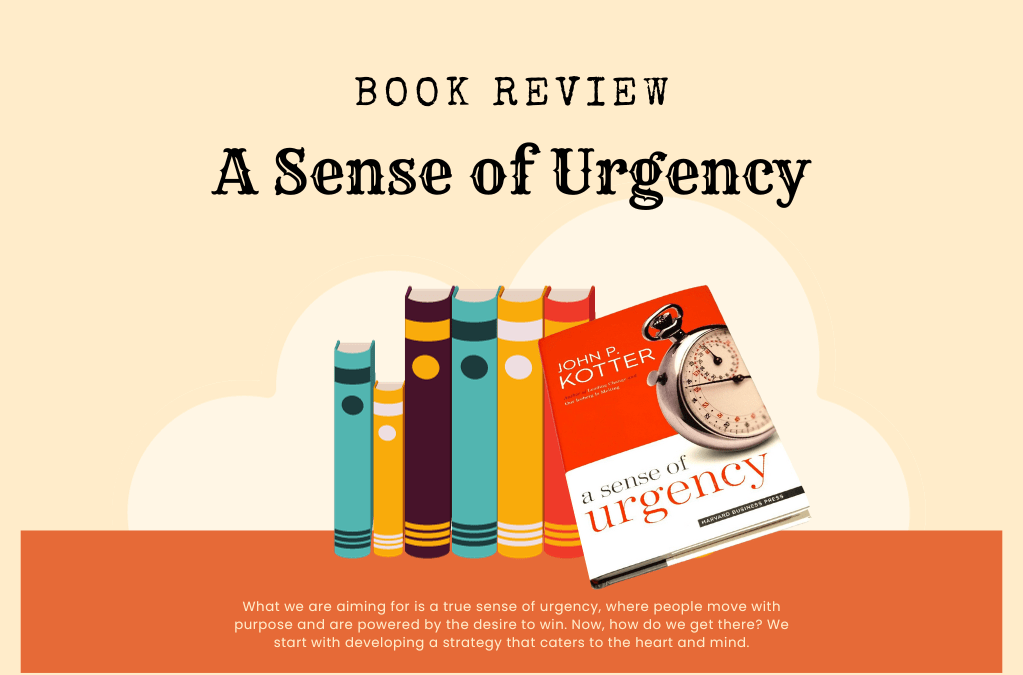
In 1996, John Kotter released a book called Leading Change, which documented an eight-step approach to drive meaningful change across an organization. Over time, Kotter heard from many of his clients and readers and learned that many struggled with the first step, creating a sense of urgency. In response, he released A Sense of Urgency in 2015 where he defined a strategy and four tactics to help kickstart an organization’s move towards greatness.
In this blog post, we’ll dive deeper into his strategy and arm you with the tools to combat this hidden threat.
Before we dive into the tactics, we wanted to share with you how Kotter defines complacency and a sense of urgency.
- Complacency is that warm and fuzzy feeling where you know what to do and you do it. It often comes after success. Folks are happy with the status quo and may not be aware of the changes in the market, which may lead the company to ruin.
- A false sense of urgency should remind you of the This is Fine meme. You and your teams may be aware that your company’s Q4 results did not meet expectations or that a competitor’s newest product was a success. However, things are frantic, and there’s a high sense of anxiety, frustration, and fear.
What we are aiming for is a true sense of urgency, where people move with purpose and are powered by the desire to win. Now, how do we get there? We start with developing a strategy that caters to the heart and mind.
When presenting your strategy to your teams, Kotter recommends that you aim for the heart. He starts the section speaking about a company that had a head of IT who knew that his company needed to update their systems or else, a competitor would take over their market share. The head put together a 150-page business case that documented every issue and recommendation and presented the facts to all necessary groups. What happened? The case was all logic. People knew the consequences, yet didn’t move with urgency. The project took an extra year to complete. It was 40% more than the target cost and only delivered 70% of the promised functionality.
Kotter says that yes, you must use logic just as the head of IT leveraged previously. And, you should communicate your goals in a way that arouses determination. Instead of showing a collection of slides, you can keep it simple. Tell a story about the company’s history and its impact on you. Use humor tastefully. Avoid lighting that would prevent you from seeing your audience. Your goal is to connect with them and give them that desire to win.
Although Kotter agrees with the use of logic and communication of goals, it must be delivered effectively. The head of IT could have kept it simple. Kotter shares these simple techniques: Tell a story about the company’s history and its impact on you; Use humor tastefully; Avoid lighting that would prevent you from seeing your audience. Your goal is to connect with them and give them that desire to win.
After setting the stage, Kotter dives into the four tactics to help you generate a sense of urgency. As an organization grows, there’s a tendency to draw inward. We may not see the challenges and opportunities in the market. We start to become satisfied with the status quo and slip into complacency. To combat this, Kotter states that you must bring “the outside in” aka tactic #1.
The easiest place to start is by listening to your teams that are already customer-facing. Kotter speaks of a district manager who visited his stores and got direct feedback from his cashiers. By doing this, he found out that the customers didn’t like the music in the stores— a data point that would have been missed if they sent out a paper survey.
Other methods include capturing videos of your customers using your product, decorating your office space with diagrams that depict the latest trends and news in the market, sending your teams out to conferences and events, and bringing external experts in.
Wherever this data comes from, Kotter urges you to not shield it from your teams. Remember to speak to your teams’ hearts and be honest with the information you have received.
With Kotter’s second tactic, you are in control. It is up to you to act with urgency in the way you speak, act, and move. He begins this section by introducing Ninan, a manager who runs three offices in Hyderabad. His firm was falling behind as new competitors entered the market. Ninan was determined to win and saw this challenge as an opportunity.
First, Ninan responded fast and moved “now”. When in meetings, he explicitly said what he was doing and by when. If someone reached out to him to chat, he immediately made time for them. How was he able to do this? He delegated and cut distractions ruthlessly. If something was not adding value and was deemed low priority, it was either removed from his slate or delegated to someone else.
In the end, Ninan led by example and cultivated a culture that led with urgent patience.
Kotter’s third tactic revolves around crises. When it comes to crises, companies either avoid and control them, use a crisis to generate urgency, or create one themselves. Each option comes with a cost. By controlling them, you may generate complacency since teams are shielded from reality. For the latter two, there’s a risk that fear and anxiety will dominate over the desire to win.
Kotter presents four mistakes that will prevent you from finding opportunity in a crisis. First, never assume that a crisis will create a sense of urgency. You must have a plan to actively address it. Secondly, don’t create problems for the sake of creating problems. A Midwestern manufacturing company manager created processes that intentionally slowed down progress. As a result, folks felt manipulated and focused their attention at the manager instead of course correcting their plant.
Thirdly, don’t wait for a crisis. Remember, tactic #1 and #2. Continue to listen to the market and act with urgency. Lastly, don’t underestimate the power of a crisis. It can quickly become a disaster if folks are unaware and act with a false sense of urgency. Instead, he urges you to be proactive on how your teams will react and develop a strategy to bring people together.
For the final tactic, Kotter opens this section by differentiating between a skeptic and a NoNo. A skeptic is actually open to new information and willing to have his or her perspective change. However, a NoNo is someone that says everything is fine and will have an excuse not to act on every challenge and opportunity that arises. They choose what information they want to hear and actively shut down any ideas, which may generate anxiety and frustration.
The two things that Kotter doesn’t recommend you doing is inviting your NoNos into your committees or leaving them out. Rather, there are three options you can leverage. First, you can distract them. Kotter shares how one company sent a NoNo to Shanghai instead of keeping them in London. The NoNo was the perfect fit. He knew how to impose discipline in order to bring Shanghai back on its feet. At the same time, the groups in London could push forward with their initiatives.
Second, you can let them go. Given your country’s employment laws, you can be direct by offering them a retirement package or firing them. Although this may be an uncomfortable method, Kotter reminds you to think about the bigger picture. Will this moment of discomfort bring greater success to your organization?
Thirdly, you can immobilize them through social pressure. At one company, after reading Kotter’s Our Iceberg is Melting, a book that talks about change by telling a story about penguins, an admin brought a stuffed penguin and hung a sign that said “NoNo is _____.” A manager’s name popped up on the sign, and then, he adjusted his behavior. Folks were able to bring the NoNos to the forefront in a lighthearted way.
By leveraging a strategy that speaks to your teams’ hearts & minds and implementing Kotter’s four tactics, your teams can move with urgency and reach success. However, the hard work doesn’t stop there. After celebrating and recognizing the success, one must anticipate that urgency will falter. You must continue to apply the four tactics to keep you and your company moving forward.
The goal is that acting with a sense of urgency becomes intertwined into you, your team, and your organization’s mindset. The journey will not be easy, and this is where all your tricks and treats will come. You might present facts about the industry in a different way or reuse a phrase that really resonated with your teams. Mix it up. Keep it light. Make one small change each day. Whatever you decide, never settle for the status quo.
In conclusion, this is the perfect day– Friday the 13th– to spend the night in and reflect on how the week has passed. Have you been frustrated by the lack of change? Do you sense anxiety among your teammates? Are people fluttering about in a state of business, but in reality, nothing is really getting done? Then, it may be time for you to arm yourself with Kotter’s tactics so that you’ll be ready to meet Jason at the door. Are you ready for it?
Don’t forget to check our review of Make it Stick: The Science of Successful Learning.

by admin | Sep 14, 2023 | InBiteSize
When I started at PlayStation back in January of 2022, it was quite the adjustment. Unlike many of my peers, it was my first job move after graduating from college. I didn’t know what I was getting into. What I did know was that the most important step was to listen and observe. Beyond that, I was given the freedom to foster a community of relentless improvement and cultivate an environment where my teams could thrive.
With those two prime directives, I set forth and summoned an unlikely hero to help my team, the Goats of Tsushima, survive the forways of game development. Who might this unlikely hero be? Meet Microsoft Whiteboard.
In this blog post, we’re continuing our tools and template series and introducing a collaboration tool that may already be part of your arsenal.
The secret powerhouse
If your company leverages Microsoft 365, then you probably didn’t know that you also get Microsoft Whiteboard. As a result, you don’t need any license agreements or subscriptions to get started. Anyone can create a whiteboard, and you can share it with anyone within your company as long as they also have a Microsoft 365 account, too. Plus, Microsoft offers a Getting Started Guide to jumpstart your usage.
Microsoft Whiteboard operates similarly to other tools in the market. Once you create a board, you are able to leverage existing templates ranging from brainstorming to ice breakers to strategy and planning and beyond. If you are feeling creative and/or cannot find one that fits your needs, you can build your own template that you can share with your colleagues. From there, you and your teams can use an array of tools, which include sticky notes, text boxes, and emojis, to share ideas and align on outcomes. In addition, there is a timer feature that helps you keep your discussions on track.
When all is said and done, the nice part is that Whiteboard integrates with Microsoft’s Active Directory (AD) so that you can quickly manage the permissions to your various whiteboards. For example, if you already had a distribution list that you used in Microsoft Outlook, such as “goats-teammembers@inbitesize.com,” then, when using the share option, you can simply add that email instead of adding all the individual group members to the board.
Where it wins is its integration with Microsoft Teams. As long as you have three participants, you can open the Whiteboard app to quickly get folks brainstorming in a virtual and/or hybrid environment. The whiteboard will remain as a tab when navigating to the meeting within Microsoft Teams so that you and your teams can quickly reference the right board and continue adding any details asynchronously. Beyond that, you can share the board with teammates who may not have been invited to the meeting.
Growing pains
Just like its competitors, Microsoft Whiteboard has its own limitations. Unfortunately, you are not able to organize your boards into projects and/or folders. Therefore, you’ll have to share your boards with the appropriate groups each time. As a workaround, I have set up a naming convention so that I can quickly find the boards I need to reference.
In addition, you have a limited selection of widgets. One of the key aspects of other tools in the market is that you can organize various objects into frames that you can hide and group, which helps with board formatting. Since you cannot organize your board into sections, there may be a limit to your participants’ focus and attention if you happen to be covering a lot of topics within your workshop. For me, I use blocks and other sticky notes to temporarily hide sections that I may not be ready to tackle.
Furthermore, if you happen to be working with external partners who may not be part of your Microsoft tenant, they will lose access to the Whiteboard once they leave the Microsoft Teams meeting. I leverage screenshots and post-meeting summaries to help keep everyone on track. (Note that they will be able to contribute as long as they were invited to the Teams meeting and your administrator has allowed access to external folks.)
Despite these limitations, Microsoft is committed to continuously evolve the tool. Be sure to check out their webpage for the latest changes.
Listen and observe
Now you may ask how did Whiteboard become an unlikely hero for us Goats? When I first joined the Goats, they had strong agile practices and knew the importance of reflecting and taking action sprint after sprint. As a result, they were actively using Google Jamboards to run their retrospectives. The good thing about the Goats was that they were a very vocal and engaged team. This meant that we quickly ran out of real estate and had to use many slides to collect all our ideas.
Hence, I introduced Microsoft Whiteboard. It was easy to transition since the tool had a similar user experience as Jamboard. Since then, we have had an endless amount of space where everyone has had a chance to share their ideas and vote on a path forward.
Beyond retrospectives, we have also used Microsoft Whiteboard to break down features and their associated use cases into bite-size chunks. To do this, we would leverage the tool to diagram customers’ journeys and sort & collect assumptions and questions that we had to validate with our stakeholders.
In conclusion
Microsoft Whiteboard is an effective contender when you’re on a budget and need a space to collaborate, fast. With its collection of templates and built-in Microsoft Teams integration, this tool can stand in for any whiteboard session and potentially pave the way for future tools like, Miro and Mural. So, get a leg up from your peers and show them this world of virtual collaboration that you can set up anytime and anywhere. How has Microsoft Whiteboard saved the day for you?
Drop us a line and let us know what tools you’re curious about.